Astronaut Koichi Wakata, KC5ZTA, has
successfully deployed the first of the 33 CubeSats that were launched to
the International Space Station in the Cygnus freighter on January 9th.
The Tuesday, February 11th deployment consisted of the first two of
the Flock-1 constellation of 28 Dove CubeSats made by Planet Labs.
In addition to the 28 Planet Labs
micro-birds, there are also four amateur radio CubeSats waiting to be
placed on-orbit. These are LituanicaSat-1, LitSat-1, ArduSat-2 and
UAPSat-1 as well as a 915 MHz CubeSat SkyCube. All are planned to be
deployed in the coming weeks.
Showing posts with label Space. Show all posts
Showing posts with label Space. Show all posts
Friday, February 21, 2014
Wednesday, February 19, 2014
Cape II Amateur Radio Satellite Cube OSCAR 75 or LO-75
The Cape II ham radio satellite is now known as the University of
Louisiana OSCAR 75 or LO-75. This according to OSCAR Number
Administrator Bill Tynan, W3XO, who recently informed AMSAT mentor Nick
Pugh, K5QXJ, of the decision.
The CAPE II ham satellite operates on 145.825 MHz FM with a CW beacon signing the call W5UL. The bird also includes a digipeaters, text to speech operation, a simplex repeater, e-mail and tweet functions. The ground station software can be downloaded at www.ulcape.org
The CAPE II ham satellite operates on 145.825 MHz FM with a CW beacon signing the call W5UL. The bird also includes a digipeaters, text to speech operation, a simplex repeater, e-mail and tweet functions. The ground station software can be downloaded at www.ulcape.org

Wednesday, February 12, 2014
Going to Space: Send Your Name to the Asteroid Bennu
If you have ever wanted to
vicariously into space, now is your chance. NASA is inviting people
around the world including ham radio operators to submit their names to
be etched on a microchip aboard a spacecraft headed to the asteroid
Bennu in 2016.
The "Messages to Bennu" microchip will travel to the asteroid aboard the Origins Spectral Interpretation Resource Identification Security Regolith Explorer spacecraft. The robotic mission will spend more than two years at the asteroid, which has a width of only about 1,760 feet. The spacecraft will collect a sample of Bennu's surface and then return it to Earth .
The deadline to submit your name online is Sept. 30, 2014. Participants who submit their names to the "Messages to Bennu" campaign will be able to print a certificate of appreciation to document their involvement. To submit your name for inclusion on this mission please take your web browser to planetary.org/bennu. While there are no instructions as to how to how to include your callsign, we found it simple to just put it right after your last name. (ANS, NASA)
The "Messages to Bennu" microchip will travel to the asteroid aboard the Origins Spectral Interpretation Resource Identification Security Regolith Explorer spacecraft. The robotic mission will spend more than two years at the asteroid, which has a width of only about 1,760 feet. The spacecraft will collect a sample of Bennu's surface and then return it to Earth .
The deadline to submit your name online is Sept. 30, 2014. Participants who submit their names to the "Messages to Bennu" campaign will be able to print a certificate of appreciation to document their involvement. To submit your name for inclusion on this mission please take your web browser to planetary.org/bennu. While there are no instructions as to how to how to include your callsign, we found it simple to just put it right after your last name. (ANS, NASA)
Tuesday, December 10, 2013
Earth and Moon Viewer
What an incredible e-mail.
Lots of great info here.
Lots of great info here.
Welcome to Earth and Moon Viewer.
Viewing the Earth
You can view either a
map of the
Earth showing the day and night regions at this moment, or view the
Earth from the
Sun,
the Moon,
the night side of the Earth, above any
location on the planet specified by latitude,
longitude and altitude, from a
satellite in Earth orbit,
or above various cities around the globe.
Images can be generated based on a
full-colour
image of the Earth
by day and night, a
topographical
map of the Earth, up-to-date
weather satellite imagery, or
a composite
image of cloud cover superimposed on a map of the Earth, a
colour composite
which shows clouds, land and sea temperatures, and ice, or the
global distribution of
water vapour.
Expert mode allows you additional control over
the generation of the image. You can compose a custom
request with frequently-used parameters and save it as a
hotlist or bookmark item in your browser.
Please consult the
Details for additional
information and answers to frequently-asked questions.
Viewing the Moon
In addition to the Earth, you can also view the Moon
from the Earth,
Sun,
night side,
above named formations on the lunar surface.
or as a
map showing day and night.
You can also make expert and
custom images of the Moon.
A related document compares the appearance of the Moon
at perigee and apogee, including an
interactive Perigee and Apogee Calculator.
Browser Requirements
To use the Earth and Moon Viewer, you need a graphical Web browser with forms
support and the ability to display GIF and JPEG images. In order to pan around
the map or globe by clicking within the image, your browser must support
"Client-Side Image Maps"—if you don't know what this means, don't worry:
if your browser doesn't support the feature, you'll see a page which explains
how to proceed.
Credits
The Earth and Moon Viewer would have been enormously more difficult to implement
without the help of the software and imagery mentioned in
the credits.
Related Software on this Site
Windows users can create images like this in real time, on their own
machines, as well as view the sky, stars at the horizon, the solar
system, orbits of asteroids and comets, and more with
Home Planet, my public domain
Earth/Space/Sky simulator available for your
downloading pleasure. Other public domain
astronomy and space software available from the same site includes:
- On the Web:
- Eclipse 2010 — Aku Aku Eclipse, Eclipse 2008 — Nuclear Ninety North, Eclipse 2001 — In Darkness: Africa, and Eclipse 1999 — Expedition to Iran.
- Moon at Perigee and Apogee.
- Solar System Live: interactive orrery.
- Switzerland from Space.
- Terranova: a new terraformed planet every day.
- Your Sky makes custom star maps for any location on Earth at any date and time.
- For Windows:
- Home Planet, Earth screen saver, Sky screen saver, Moontool, Craters screen saver, and an Excel catalogue of the Palomar Observatory Sky Survey.
- For Unix (X/OpenWindows):
- Moontool, and Xsunclock.
Saturday, November 2, 2013
Laser Speed Demo in Space
NASA has used laser technology to transfer data over the 239,000 miles
to and from the moon. This at a speed of 622 megabits per second.
Badri Younes is NASA's deputy associate administrator for space communications and navigation. In a press release he said that his agency is encouraged by the results of the demonstration of the Lunar Laser Communication Demonstration to this point. As such NASA is confident that it is on the right path to introduce this new capability into operational service soon.
The space agency’s Lunar Laser Communication Demonstration is the first two-way space communication system to use a laser instead of radio. Younes calls it the first step on NASA’s roadmap toward building the next generation of space communication capability.
The Lunar Laser Communication Demonstration is hosted on NASA's Lunar Atmosphere and Dust Environment Explorer or LADEE satellite. (NASA)
Badri Younes is NASA's deputy associate administrator for space communications and navigation. In a press release he said that his agency is encouraged by the results of the demonstration of the Lunar Laser Communication Demonstration to this point. As such NASA is confident that it is on the right path to introduce this new capability into operational service soon.
The space agency’s Lunar Laser Communication Demonstration is the first two-way space communication system to use a laser instead of radio. Younes calls it the first step on NASA’s roadmap toward building the next generation of space communication capability.
The Lunar Laser Communication Demonstration is hosted on NASA's Lunar Atmosphere and Dust Environment Explorer or LADEE satellite. (NASA)
Monday, October 7, 2013
LADEE Spacecraft goes into Lunar Orbit
NASA's Lunar Atmosphere and Dust Environment Explorer or LADEE
spacecraft fired its engines Sunday morning, October 6th, slowing it
enough to be captured by lunar gravity and placing it into orbit around
the Moon. Once given the green light the spacecraft will begin its
mission to study the Moon's exotic and almost transparent atmosphere,
which is highly affected by space weather. That information will be
sent by radio back to Earth for further analysis.
Monday, June 10, 2013

Wednesday, June 5, 2013

Friday, February 15, 2013
Metorite Impacts Russia; 500 injured.
Meteorite hits Russian Urals: Fireball explosion wreaks havoc, up to 500 injured (PHOTOS, VIDEO)
Click Here
http://rt.com/news/meteorite-crash-urals-chelyabinsk-283/
Close Earth Flyby of Asteroid
At 2:25 p.m. EST (19:25 UTC) on Friday, Feb. 15th,
asteroid 2012
DA14 will fly past Earth only 17,200 miles above
our planet's surface. This will put it well inside
the orbit of geosynchronous satellites, closer than
any asteroid of the same size has come since regular
sky surveys began in the 1990s. Researchers speculate
that Earth's gravity might even cause seismic
activity on the 50m-wide space rock. Click to
view a computer simulation of the flyby, courtesy
of NASA:
source;
SpaceWeather.com
http://spaceweather.com/
NASA
http://www.nasa.gov/mission_pages/asteroids/news/asteroid20130201315144.html
During the hours around closest approach,
the asteroid will brighten until it resembles a
star of 8th magnitude. Theoretically, that’s an
easy target for backyard telescopes. The problem
is speed. The asteroid will be racing across the
sky, moving almost a full degree (or twice the width
of a full Moon) every minute. That’s going to be
hard
to track. Only the most experienced amateur
astronomers are likely to succeed. For the rest
of us, NASA will broadcast the asteroid's flyby
on
NASA TV.
Asteroid 2012 DA14 is about the same
size as previous asteroids responsible for the Meteor
Crater in Arizona and the Tunguska Event in Siberia.
Unlike those objects, however, 2012 DA14
will not hit Earth. Even if seismic activity
breaks the asteroid apart, there is no danger; the
fragments would continue along the same non-intersecting
path as the original asteroid.source;
SpaceWeather.com
http://spaceweather.com/
NASA
http://www.nasa.gov/mission_pages/asteroids/news/asteroid20130201315144.html
Monday, February 20, 2012
Venus and Jupiter at Sunset
The brightest planets in the night sky are aligning for a must-see show in late February and March 2012. You can start looking tonight.
[video]
[full story]
[video]
[full story]
Friday, January 20, 2012
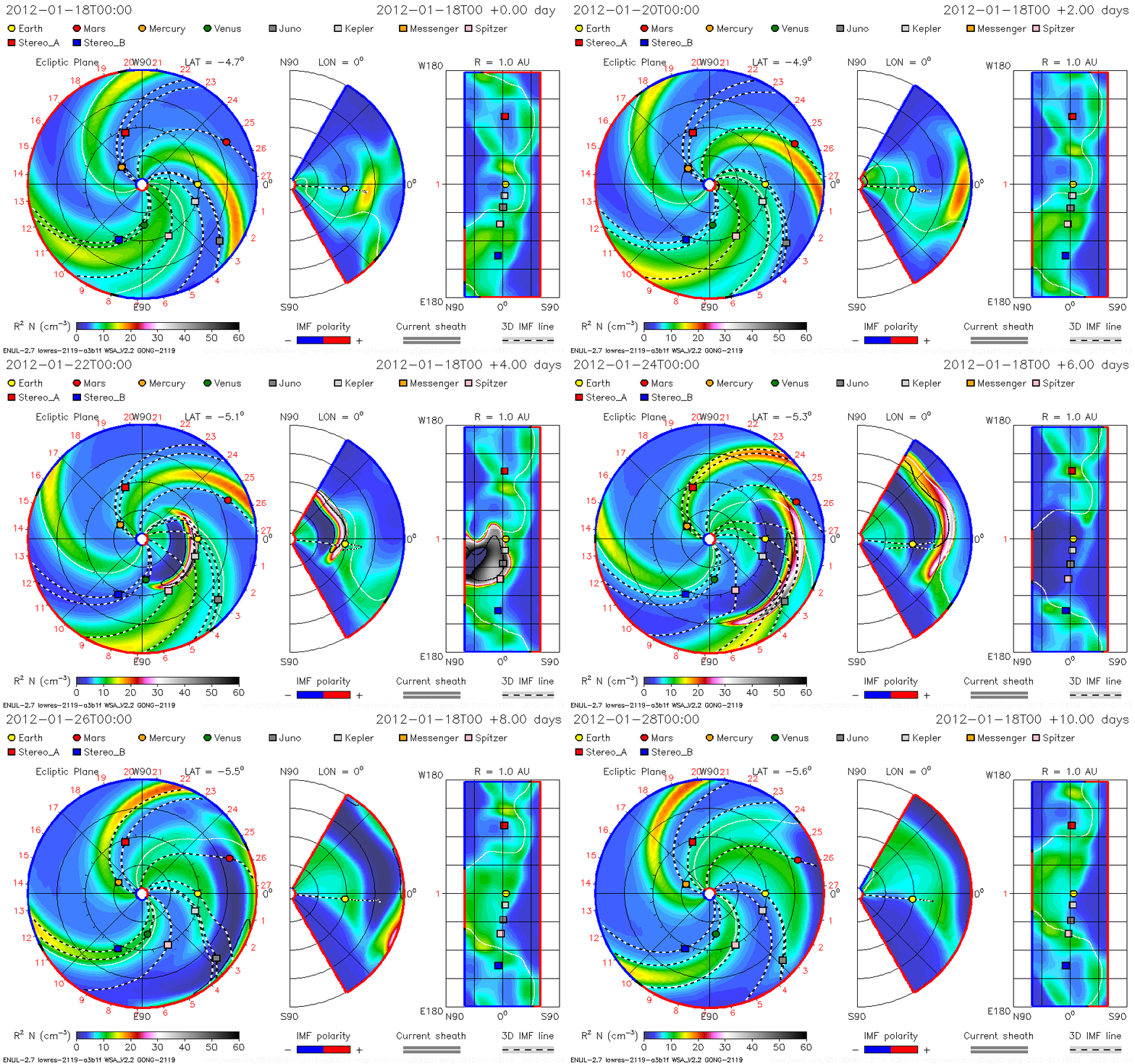
Earth-directed CME to Impact on Jan. 21, 2012
Active sunspot 1401 erupted yesterday, Jan. 19th around 16:30 UT, producing an M3-class solar flare and a full-halo coronal mass ejection (CME). The Solar and Heliospheric Observatory recorded the cloud expanding almost directly toward Earth:
Analysts at the Goddard Space Weather Lab say strong geomagnetic storms are possible when the cloud arrives this weekend. Their animated forecast track predicts an impact on Jan. 21st at 22:30 UT (+/- 7 hrs).
The cloud is also heading for Mars, due to hit the Red Planet on Jan. 24th. NASA's Curiosity rover, en route to Mars now, is equipped to study solar storms and might be able to detect a change in the energetic particle environment when the CME passes by.
Analysts at the Goddard Space Weather Lab say strong geomagnetic storms are possible when the cloud arrives this weekend. Their animated forecast track predicts an impact on Jan. 21st at 22:30 UT (+/- 7 hrs).
The cloud is also heading for Mars, due to hit the Red Planet on Jan. 24th. NASA's Curiosity rover, en route to Mars now, is equipped to study solar storms and might be able to detect a change in the energetic particle environment when the CME passes by.
Tuesday, December 27, 2011
CME expected at Earth on 28 December 2011
New sunspot 1387 erupted during the late hours of Christmas Day, producing an M4-class flare and hurling a CME toward Earth and Mars. Click to view an animated forecast track prepared by analysts at the Goddard Space Weather Lab:
The CME is expected to deliver a glancing blow to Earth's magnetic field on Dec. 28th at 1200 UT and a direct hit to the planet Mars on Dec. 30th at 1800 UT. Using onboard radiation sensors, NASA's Curiosity rover might be able to sense the CME when it passes the rover's spacecraft en route to Mars. Here on Earth, NOAA forecasters estimate a 30-to-40% chance of geomagnetic storms on Dec. 28th when the CME and an incoming solar wind stream (unrelated to the CME) could arrive in quick succession.
The CME is expected to deliver a glancing blow to Earth's magnetic field on Dec. 28th at 1200 UT and a direct hit to the planet Mars on Dec. 30th at 1800 UT. Using onboard radiation sensors, NASA's Curiosity rover might be able to sense the CME when it passes the rover's spacecraft en route to Mars. Here on Earth, NOAA forecasters estimate a 30-to-40% chance of geomagnetic storms on Dec. 28th when the CME and an incoming solar wind stream (unrelated to the CME) could arrive in quick succession.
Tuesday, November 8, 2011
Asteroid 2005 YU55
2005 YU55, an asteroid larger than an aircraft carrier, is expected to pass by Earth at 6:28 p.m. EST today, but NASA says there is no chance it will collide with the Earth or moon.
NASA radars are monitoring 2005 YU55, an asteroid the size of an aircraft carrier, as it heads for a flyby of the Earth-Moon system later today. There is no danger to our planet. At closest approach on Tuesday, Nov. 8th, at 3:28 pm PST (23:28 UT), the 400m-wide space rock will be 324,600 kilometers away, about 85% the distance from Earth to the Moon. Professional astronomers are eagerly anticipating the flyby as the asteroid presents an exceptionally strong radar target. Powerful transmitters at Goldstone and Arecibo will ping the space rock as it passes by, revealing the asteroid's shape and texture in crisp detail, and pinpointing its orbit for future flyby calculations.
NASA radars are monitoring 2005 YU55, an asteroid the size of an aircraft carrier, as it heads for a flyby of the Earth-Moon system later today. There is no danger to our planet. At closest approach on Tuesday, Nov. 8th, at 3:28 pm PST (23:28 UT), the 400m-wide space rock will be 324,600 kilometers away, about 85% the distance from Earth to the Moon. Professional astronomers are eagerly anticipating the flyby as the asteroid presents an exceptionally strong radar target. Powerful transmitters at Goldstone and Arecibo will ping the space rock as it passes by, revealing the asteroid's shape and texture in crisp detail, and pinpointing its orbit for future flyby calculations.
Asteroids this big have passed by Earth at similar distances many times before, but this is the first time astronomers have known about the flyby in advance. For instance, a similar encounter occurred in 1976 when 2010 XC15 split the distance between Earth and the Moon. Researchers didn't discover that space rock until 24 years after the flyby. The Nov. 8, 2011, passage of 2005 YU55 thus represents a rare opportunity for asteroid research.
Experienced amateur astronomers should be able to photograph 2005 YU55 as it zips through the constellations Aquila and Pegasus glowing like an 11th magnitude star. Even under the full moonlight of Nov. 8th, such a bright asteroid is within reach of mid-sized backyard telescopes. The timing of the flyby favors observers in western Europe and eastern parts of North America. Check Sky & Telescope for observing tips or go straight to JPL for the object's ephemeris.
Saturday, October 15, 2011
Comet Elenin
Today the world will not end! The supposed “Doomsday” comet Elenin will pass by, but at 35 million km or 90 times the Earth Moon distance, it will have NO effect on us at all.
It is about 3-5km wide and has the consistency of a slushee or snowy dirtball. It is so feeble that a strong solar storm in August appears to broken it into smaller pieces. Rising in the east very early in the morning at magnitude 10 it is not visible to the eye or even moderate sized telescope. An image by Michael Mattiazzo can be seen at:
http://members.westnet.com.au/mmatti/sc.htm
It is about 3-5km wide and has the consistency of a slushee or snowy dirtball. It is so feeble that a strong solar storm in August appears to broken it into smaller pieces. Rising in the east very early in the morning at magnitude 10 it is not visible to the eye or even moderate sized telescope. An image by Michael Mattiazzo can be seen at:
http://members.westnet.com.au/mmatti/sc.htm
Saturday, September 10, 2011
GEOMAGNETIC STORM
GEOMAGNETIC STORM: A CME hit Earth's magnetic field on Sept. 9th, and the impact ignited a geomagnetic storm, in progress. Northern Lights have since been spotted in the United States as far south as as Michigan, Montana and North Dakota. This could be the first of several hits from a series of CMEs expected to reach Earth during the weekend, so more geomagnetic activity is in the offing~
Remember, Geomagnetic storms can cause difficulties in communicating over long distances
Many communication systems utilize the ionosphere to reflect radio signals over long distances. Ionospheric storms can affect radio communication at all latitudes. Some radio frequencies are absorbed and others are reflected, leading to rapidly fluctuating signals and unexpected propagation paths. TV and commercial radio stations are little affected by solar activity, but ground-to-air, ship-to-shore, Voice of America, Radio Free Europe, and amateur radio are frequently disrupted. Radio operators using high frequencies rely upon solar and geomagnetic alerts to keep their communication circuits up and running.
Some military detection or early-warning systems are also affected by solar activity. The Over-the-Horizon Radar bounces signals off the ionosphere in order to monitor the launch of aircraft and missiles from long distances. During geomagnetic storms, this system can be severely hampered by radio clutter. Some submarine detection systems use the magnetic signatures of submarines as one input to their locating schemes. Geomagnetic storms can mask and distort these signals.
More info; http://www.arrl.org/news/the-k7ra-solar-update-181
Tuesday, August 9, 2011
Massive X6.9 Class Solar Flare
August 9, 2011 - The largest flare of the solar cycle, an R3 (Strong) Radio Blackout, alternatively classified as an X6, occurred today at 0805Z. Region 1263, now poised near the west limb, produced the event and a few others of lesser magnitude in the past day. The region remains hot at this writing.
A quick rise in the protons at GOES reached S1 (Minor) levels soon after the eruption. Given the location of the activity, any CMEs would likely be directed away from Earth so no significant Geomagnetic Storm activity is forecast.
*Solar Storms May Disrupt Gadgets
*Power companies prepare as solar storms set to hit Earth
Sunday, July 3, 2011
Asteroid to Disappear?
Asteroid Occulatation;
On July 3rd at 11:05:30 p.m. EDT, a 10th magnitude star in Virgo will disappear. It'll be right back. Asteroid 52 Europa will pass in front of TYC 0292-00339-1, blotting it out for only 17.9 seconds in an eclipse visible across a wide strip of North America. Measurements of the eclipse could reveal the shape of the asteroid, the seventh largest in the asteroid belt. NASA is hosting a live chat and webcast to cover the event: Tune in here.
Definition of OCCULTATION
On July 3rd at 11:05:30 p.m. EDT, a 10th magnitude star in Virgo will disappear. It'll be right back. Asteroid 52 Europa will pass in front of TYC 0292-00339-1, blotting it out for only 17.9 seconds in an eclipse visible across a wide strip of North America. Measurements of the eclipse could reveal the shape of the asteroid, the seventh largest in the asteroid belt. NASA is hosting a live chat and webcast to cover the event: Tune in here.
Definition of OCCULTATION
1: the state of being hidden from view or lost to notice
2: the interruption of the light from a celestial body or of the signals from a spacecraft by the intervention of a celestial body; especially : an eclipse of a star or planet by the moon
Thursday, June 16, 2011
Chance of Solar Flares
The magnetic field of sunspot 1236 harbors energy for M-class solar flares. NOAA forecasters estimate a 25% chance of such an eruption during the next 24 hrs.
Subscribe to:
Posts (Atom)
My Stamp Collecting Blog

Counter Added January 1, 2011