Monday, September 6, 2010

Update; SOLAR FLARE:

A little more than an hour ago, magnetic fields above sunspot 1105 reconnected, producing a brief but explosive C1-class solar flare. NASA's Solar Dynamics Observatory recorded a bright flash of extreme UV radiation from the blast site: 0.7 MB movie. Sunspot 1105 is growing rapidly and seems poised to produce more flares in the hours ahead.

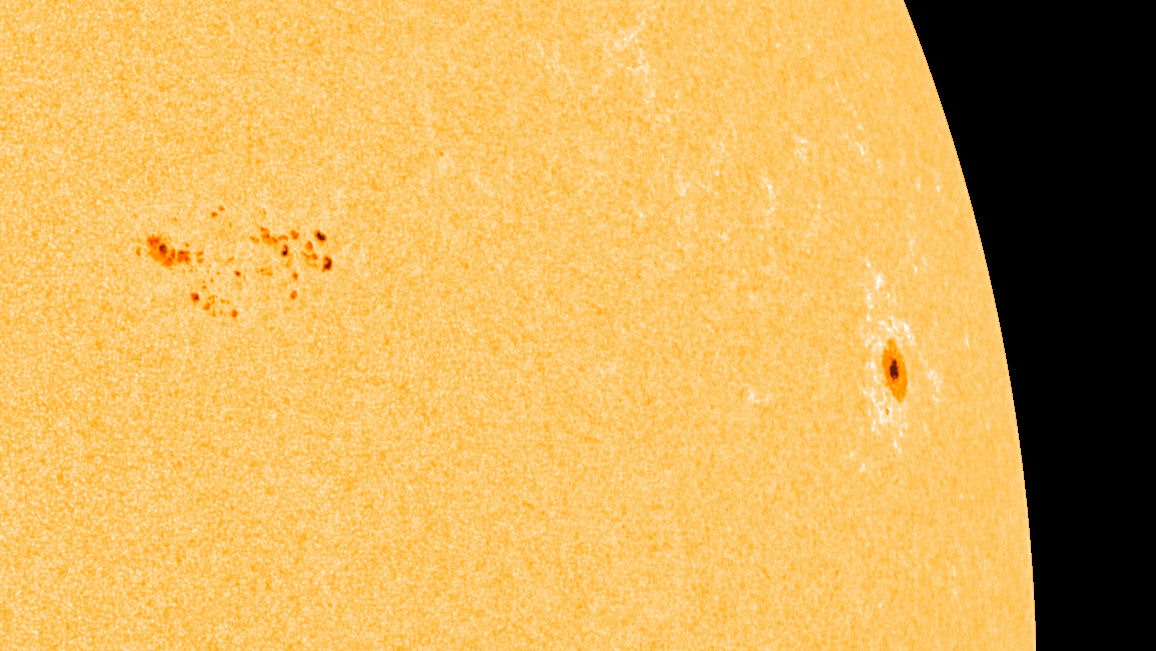
It looks like the sun has developed rash. Sunspot group 1105 consists of more than 25 tiny spots scattered across an area some 40,000 km wide. Sascha Somodji sends this picture of the busy active region from his backyard observatory in Krefeld, Germany:

Sunspot group 1105 stands in marked contrast to nearby sunspot 1101, which consists of a single dark core. (Click here to see the two side by side.) If sunspot 1101 looks boring, that's because it is. The sunspot's magnetic underpinnings resemble a simple dipole, and the spot is correspondingly quiet. Sunspot group 1105, on the other hand, is much more complicated with a profusion of opposite magnetic polarities popping up and bumping together. Magnetic reconnection is happening there almost non-stop, causing sunspot 1105 to crackle with B-class solar flares. It is, indeed, a "rash sunspot."

more images: from Steve Rismiller of Milford, Ohio; from John Stetson of Portland, Maine; from Rolf Girssmann of Boostedt, Germany; from Cai-Uso Wohler of Bispingen, Germany;


source

The Amateur's Code.

I remember the first time I read this. I had my ticket for about 2-3 weeks. I have it in a frame here in the shack. It was on the wall at one time.
Sometimes these rules are forgotten. So I figured it was a good time to post.

The Amateur's Code

The Radio Amateur is CONSIDERATE...never knowingly operates in such a way as to lessen the pleasure of others.

LOYAL...offers loyalty, encouragement and support to other amateurs, local clubs, and the American Radio Relay League, through which Amateur Radio in the United States is represented nationally and internationally.

PROGRESSIVE...with knowledge abreast of science, a well-built and efficient station and operation above reproach.

FRIENDLY...slow and patient operating when requested; friendly advice and counsel to the beginner; kindly assistance, cooperation and consideration for the interests of others. These are the hallmarks of the amateur spirit.

BALANCED...radio is an avocation, never interfering with duties owed to family, job, school or community.

PATRIOTIC...station and skill always ready for service to country and community.

Sunday, September 5, 2010

Uniden HomePatrol

OMG, I got to get me one of these. When I saw the price I was shocked. Then after doing some research I have discovered that some of these units are all ready in the public.
I could not believe how technologically advanced this scanner is.
When I get this unit I will write a review.

Here are a couple of videos along with a couple of links.


HomePatrol web-site

HomePatrol Demo

What You will Receive; enter your zip code

Saturday, September 4, 2010

Sun - Diferentional rotation of plasma

A question was asked; Dose the Sun Rotate?
This is a great video with the answer.

Wednesday, September 1, 2010

M.A.A.R.C. 2 Meter Net

I'm NCS tonight on the M.A.A.R.C. 2 meter net. Due to the current Hurricane and other Tropical Storms in the Atlantic I think I will talk about the Hurricane Watch Net.
The Hurricane Watch Net was established in 1965 for the purpose of providing support to the National Hurricane Center during times of tropical storm emergencies. Through our associated network of Amateur Radio Operators, emergency communications support to the NHC is of primary interest.
The Hurricane Watch Net and the operation at WX4NHC at the National Hurricane Center in Miami are manned entirely by volunteers. We activate whenever a system has achieved hurricane status and is within 300 miles of populated land mass or at the request of the National Hurricane Center.

Net operations are conducted on 14.325 MHz.

The Hurricane Watch Net serves two purposes:
  1. To disseminate the latest National Weather Service advisories on active hurricanes in both the Atlantic and Pacific side of the Americas. This includes transmissions to any maritime amateur radio operators that may be in the affected area.
  2. To gather real-time ground level weather conditions from amateurs in the affected areas and to get these reports to the National Hurricane Center via WX4NHC in a timely and accurate fashion.
Along with these weather reports, often come reports on damaged roads power outages, structural damage, phone and communications links, and of course reports on injuries and deaths. These non-weather report items are usually relayed to other nets in operation on 20, 40, and 80 who are focusing on Health & Welfare, or by the crew at WX4NHC to the appropriate agencies that stay in touch with the National Hurricane Center.
For more info on the Hurricane Watch Net visit their web-site; http://www.hwn.org/

Monday, August 30, 2010

TechNet

On August 5th, I went to the M.A.A.R.C. Meeting and discussed to those in attendance about the club hosting a TechNet on the 146.940 repeater.

This is a sample of what I am thinking of in response from of those interested in being a part of the TechNet;

M.A.A.R.C. TechNet.

Topics include the latest news in the worlds manned and unmanned space programs, aeronautics, astronomy events and new discoveries. We will also cover Amateur Astronomy, Model, Mid and High Powered Rocketry, as well as Amateur Radio activities related to space such as monitoring meteor activity, contacting the International Space Station, using Amateur Radio Satellites, EME (Moonbounce) and how to use Orbital Plotting software.
Outside of Space topics we will also discuss;
How to use your radio, Radio Orienteering,Building mini transmitters for ROCA, Antenna Construction,Sound Card-to-Rig Interfaces, Cables and Connectors, DSP Manufacturers, Interfaces Manufacturers, Radio Manufacturers, Packet Radio, PSK31, Radio Programming Cables, RTTY, Ham Radio Software, Networking issues, Operating System issues and many other High Tech Radio-Computer related issues. This is just a few suggestions.

Saturday, August 28, 2010

Tower Climb to 1768 Feet

This is being sent on twitter and e-mails. Seems like everyone is seeing it. I would climb this tower.

Friday, August 27, 2010

Earth's atmosphere/ Shrinking

THE upper reaches of Earth's atmosphere are unexpectedly shrinking and cooling due to lower ultraviolet radiation from the sun, US scientists say.

The sun's energy output dropped to unusually low levels from 2007 to 2009, a significantly long spell with virtually no sunspots or solar storms, according to scientists from the National Centre for Atmospheric Research in Boulder, Colorado.

During that period, the thermosphere, whose altitude ranges from about 90-500km, shrank and contracted from the sharp drop in ultraviolet radiation, said the study published in the American Geophysical Union's journal Geophysical Research Letters.

A narrower, less dense thermosphere is good news for satellites orbiting Earth, including the International Space Station, since reduced friction means they can remain aloft longer, said University of Colorado professor and study co-author Thomas Woods.

source

Thursday, August 26, 2010

Tmate (what your SDR always wanted)

This is really cool, A friend sent this to me. We talked about this while on Echo-Link. Seems like the really cool stuff is going on in Europe.

Tmate is the most awaited accessory by many users of SDR radio that can not or will not stay without the VFO knob! With a classical tuning knob, the USB interface and the upgradable software, allows the control of main functions of the various SDR software. Intended mainly to allow the use of SDR software without the need to watch the screen of the PC, or when the screen of the PC is crowded by various programs such as LOG or software for DIGITAL operations or CONTEST
.


Wednesday, August 25, 2010

Meteor Explosion

AUSTRALIA - Meteor explosion wows community. Many residents heard the loud rumble, and some were even lucky enough to see something in the sky, but simply everyone is talking about the supposed meteor that exploded over the Tombong area last Tuesday afternoon. A huge number of locals report having heard a loud unexplained “thundering” noise on Tuesday at around 2pm, while others tell of seeing a light falling through the sky at around the same time. No one got quite as close as a local Country Energy worker who was preparing to climb a power pole to make repairs. He suddenly noticed a light in the sky, which started traveling straight towards him in an east to west direction. He knew the bright object was traveling far too quickly to be an aircraft, and he watched in astonishment for over 20 seconds as it flew over the top of him, making a loud hissing or “swooshing” sound. He said the initially bright object dulled and broke up into four or five pieces, with a huge roar to be heard.
“Everything shook. I’ve never been in an earthquake, but it was that kind of a thing.”
Two reports had been registered on the Sydney Observatory ‘Lights in the Sky’ blog page that most likely related to the occurrence. The reports tell of sightings of a daytime meteor between 1.50pm and 2pm on the Tuesday. “A meteor bright enough to be seen during the day may well be sufficiently large to survive the journey through the atmosphere and become a meteorite on the ground. However, unless it was seen to land we are unlikely to ever find out.”

Friday, August 20, 2010

Isotron Antennas

So here I am looking at different antennas. Anyone of my readers have any experience with the Isotron Antenna?
I'm looking to purchase the 75/80.
I did hear from a local ham that they are a good antenna.
I also heard from another local ham that they are not worth a dime.

Isotron Antenna Home Page

Thursday, August 19, 2010

Working Amateur Radio Satellites

In recent weeks I have a several local hams ask me how to get started into being able to work Satellites.
It is not rocket science to be able to listen to the birds in outer space nor is it to transmit.
It dose however require some time, practice and research.

I always suggest obtaining some type of orbital plotting software; once you get it take some time to understand it.
Ounce you have achieved that then pick out a Satellite and listen to it for a few days. After you have done that then try and make your first contact. It may take you a day or a few weeks. The thing is never give up.

Equipment, that can be pricey it you want it to be. I have always been one for buying the best. I know not everyone is able to that. Heck, I fall into that boat currently.
My suggestion for equipment is a good duel band HT. I have a VX-7R; I’m hoping to get the new VX-8R soon.
Next, the Antenna, you can make one if you wish but I suggest you save the time and hassle and purchase on. Arrow makes a nice 3 element VHF, 7 element UHF with a 10 watt duplexer.
Here are a couple of videos and I hope these help those of you with questions.


How to work amateur radio satellites with your handheld (HT) radio from moleculo on Vimeo.

Wednesday, August 18, 2010

METEOR ECHOES

The Air Force Space Surveillance Radar is scanning the skies above Texas. When a meteor or satellite passes over the facility--ping!--there is an echo. Click on the button to listen to a live audio feed.

http://topaz.streamguys.tv/~spaceweather/

CME Missed Us.

Thank you to those of you who emailed me this;
The CME expected to hit Earth's magnetic field on Aug. 17th either missed or delivered such a feeble blow that no one noticed the resulting geomagnetic disturbance. The next opportunity for auroras is Aug. 24th when an incoming solar wind stream could provoke polar geomagnetic storms.
I also saw this on SpaceWeather.com

My Stamp Collecting Blog

Counter Added January 1, 2011

free counters

HOW TO READ PROPAGATION NUMBERS

The A index [ LOW is GOOD ]

  • 1 to 6 is BEST
  • 7 to 9 is OK
  • 11 or more is BAD

Represents the overall geomagnetic condition of the ionosphere ("Ap" if averaged from the Kp-Index) (an average of the eight 3-hour K-Indices) ('A' referring to amplitude) over a given 24 hour period, ranging (linearly) typically from 1-100 but theoretically up to 400.

A lower A-Index generally suggests better propagation on the 10, 12, 15, 17, & 20 Meter Bands; a low & steady Ap-Index generally suggest good propagation on the 30, 40, 60, 80, & 160 Meter Bands.

SFI index [ HIGH is GOOD ]

  • 70 NOT GOOD
  • 80 GOOD
  • 90 BETTER
  • 100+ BEST

The measure of total radio emissions from the sun at 10.7cm (2800 MHz), on a scale of 60 (no sunspots) to 300, generally corresponding to the sunspot level, but being too low in energy to cause ionization, not related to the ionization level of the Ionosphere.

Higher Solar Flux generally suggests better propagation on the 10, 12, 15, 17, & 20 Meter Bands; Solar Flux rarely affects the 30, 40, 60, 80, & 160 Meter Bands.

K index [ LOW is GOOD ]

  • 0 or 1 is BEST
  • 2 is OK
  • 3 or more is BAD
  • 5 is VERY VERY BAD

The overall geomagnetic condition of the ionosphere ("Kp" if averaged over the planet) over the past 3 hours, measured by 13 magnetometers between 46 & 63 degrees of latitude, and ranging quasi-logarithmically from 0-9. Designed to detect solar particle radiation by its magnetic effect. A higher K-index generally means worse HF conditions.

A lower K-Index generally suggests better propagation on the 10, 12, 15, 17, & 20 Meter Bands; a low & steady Kp-Index generally suggest good propagation on the 30, 40, 60, 80, & 160 Meter Bands.

Terms of Service

[In accordance with Title 17 U.S.C. Section 107, this material is distributed without profit, for research and/or educational purposes. This constitutes 'FAIR USE' of any such copyrighted material.]
I am not responsible for any thing that happens to your mental health, computer and all personal property because you visited my site.
This site is a collection of some things sent to me by e-mail, obtained from other blogs and the internet. If there is a picture or quote that is copyrighted to you let me know and I will remove your item .
Thoughts expressed in my blog are just that . I give My Opinion on the many events, products and how too, reported by the media and other web-sites.
Do not use this blog site to obtain weather events or disasters information. What I post may not be correct. Always get information from the proper media, weather (NWS)(NOAA)
Pacific Tsunami Warning Center and USGS sites