Houston, VAFB had a problem........
Yes indeed, a Big problem this morning.
The launch of three Amateur Radio satellites on a Taurus XL rocket has ended in failure.
The satellites were launched from Vandenberg Air Force Base at 10:09:45 UT Friday, March 4 on an Orbital Sciences Taurus XL rocket.
The rocket's fairing, the part of the rocket which covers the satellite on top of the launcher, did not separate properly so the Taurus XL did not have enough velocity to enter orbit.
The rocket is believed to have crashed near the Antarctic; the Amateur Radio satellites Explorer-1, KySat-1 and Hermes were all lost.
Watch Glory Launched, but Separation Failed / Orbital Sciences Taurus Rocket
source
Friday, March 4, 2011
Articles of Interest and Contest Opportunities.
Lots going on this week. Myself I have more things going on than I care for.
Let's hope next week is better.
Have a great weekend.
Articles of Interest
No HF Frequencies Being Used in New Zealand Earthquake Operations
Amateur MF Allocation Moves a Step Closer
Ham Radio Is More Than a Hobby For NMARES Club (Washington)
GOP Targets Public Radio, Amateur Radio, and PBS
The FCC hunts down a Los Angeles pirate
Oceanside adopts ham radio ordinance (California)
Propagation Reports
Solar Report 1415 04 Mar 2011
Forecast Space Weather 1415 04 Mar 2011
Sunspots 1415 04 Mar 2011
This Weekends Contest
Let's hope next week is better.
Have a great weekend.
Articles of Interest
No HF Frequencies Being Used in New Zealand Earthquake Operations
Amateur MF Allocation Moves a Step Closer
Ham Radio Is More Than a Hobby For NMARES Club (Washington)
GOP Targets Public Radio, Amateur Radio, and PBS
The FCC hunts down a Los Angeles pirate
Oceanside adopts ham radio ordinance (California)
Propagation Reports
Solar Report 1415 04 Mar 2011
Forecast Space Weather 1415 04 Mar 2011
Sunspots 1415 04 Mar 2011
This Weekends Contest
| QRP Fox Hunt | Mar 4 |
| NCCC Sprint | Mar 4 |
| ARRL Inter. DX Contest, SSB | Mar 5-6 |
| Wake-Up! QRP Sprint | Mar 5 |
| Open Ukraine RTTY Championship | Mar 5-6 |
| DARC 10-Meter Digital Contest | Mar 6 |
| RSGB 80m Club Championship, Data | Mar 7 |

Wednesday, March 2, 2011
Wouxun KG-UV920R (RESERVATION)
I have recieved a lot of e-mails asking me if I have any details on the KG-UV920R Dual-Band Mobile by Wouxun.
Wouxun has not set a price on this radio yet and has stated that the price will be competitive.
At this point I know Wouxun US is taking reservations for this radio.
For more details; Click Here
Previous Post;
Sunday, October 24, 2010 Wouxun KG-UV920R Mobile
Wouxun has not set a price on this radio yet and has stated that the price will be competitive.
At this point I know Wouxun US is taking reservations for this radio.
For more details; Click Here
Previous Post;
Sunday, October 24, 2010 Wouxun KG-UV920R Mobile
Saturday, February 26, 2011
Really Cool Dipole
This is a really cool, eye opening set-up.
I mean this antenna looks cool in the carrying case and set-up.
The real eye opener is the price, Big Ouch.
I am not going to waste your and my time with photos and the write up, just a link.
Click Here
I mean this antenna looks cool in the carrying case and set-up.
The real eye opener is the price, Big Ouch.
I am not going to waste your and my time with photos and the write up, just a link.
Click Here
Friday, February 25, 2011
Monster Solar Prominence Captured by SDO

The Sun continues to be active! A large-sized (M 3.6 class) flare occurred near the edge of the Sun on February 24, 2011, and it blew out a gorgeous, waving mass of erupting plasma that swirled and twisted over a 90-minute period. This event was captured in extreme ultraviolet light by NASA’s Solar Dynamics Observatory spacecraft. Some of the material blew out into space and other portions fell back to the surface. Because SDO images are super-HD, the scienctists can zoom in on the action and still see exquisite details. The video above was created using a cadence of a frame taken every 24 seconds; still, the sense of motion is, by all appearances, seamless. Sit back and enjoy the jaw-dropping solar show. See one of the images, below.
Spaceweather.com reports that Earth was little affected by this blast, as plasma clouds produced by the blast did not come our way.
The latest active sunspot — #1163 — is currently behind the Sun’s eastern limb, but be turning toward Earth in the days ahead, setting the stage for more activity if the eruptions continue.A Video for you to check out as well.
Articles of Interest and Contest Opportunities
Here we at the beginning of a new weekend. Heck, today is the 56th day of this new year.
I have here this weekends contest opportunities along with some articles of interest.
Have a great weekend all, hope to hear you on the bands.
Contest Opportunities This Weekend
Articles of Interest
He's still getting the word out
He's an amateur radio operator (also known as a ham), a retired cryptographer, a retired naval officer and a retired director of the county's Emergency ...
Radio hams are contacting world
MEMBERS of Gisborne Amateur Radio Club will transmit from the top of Kaiti Hill this weekend, competing against the 63 other clubs throughout New Zealand to ...
Amateur Radio Association to offer opportunity to learn about 'ham ...
Waldo County Amateur Radio Association is participating in the American Radio Relay League's International DX Contest on Saturday, March 5, and all amateur ...
A 'ham' remembers going to war
McCarty enlisted in the US Army in 1942, but before that he was interested in amateur radio and developed skills he thought he could use in the military. ...
Neighbors Notes - Amateur radio club event, 'Hooray for Hollywood ...
Battleship NOrth Carolina | The Azalea Coast Amateur Radio Club will operate from the Battleship North Carolina during the North Carolina QSO Party noon-10 ...
I have here this weekends contest opportunities along with some articles of interest.
Have a great weekend all, hope to hear you on the bands.
Contest Opportunities This Weekend
| QRP Fox Hunt | Feb 25 |
| NCCC Sprint Ladder | Feb 25 |
| CQ 160-Meter Contest, SSB | Feb 25-27 |
| REF Contest, SSB | Feb 26-27 |
| UBA DX Contest, CW | Feb 26-27 |
| Mississippi QSO Party | Feb 26-27 |
| North American QSO Party, RTTY | Feb 26-27 |
| North Carolina QSO Party | Feb 27-28 |
| CQC Winter QSO Sprint | Feb 28 |
Articles of Interest
He's still getting the word out
He's an amateur radio operator (also known as a ham), a retired cryptographer, a retired naval officer and a retired director of the county's Emergency ...
Radio hams are contacting world
MEMBERS of Gisborne Amateur Radio Club will transmit from the top of Kaiti Hill this weekend, competing against the 63 other clubs throughout New Zealand to ...
Amateur Radio Association to offer opportunity to learn about 'ham ...
Waldo County Amateur Radio Association is participating in the American Radio Relay League's International DX Contest on Saturday, March 5, and all amateur ...
A 'ham' remembers going to war
McCarty enlisted in the US Army in 1942, but before that he was interested in amateur radio and developed skills he thought he could use in the military. ...
Neighbors Notes - Amateur radio club event, 'Hooray for Hollywood ...
Battleship NOrth Carolina | The Azalea Coast Amateur Radio Club will operate from the Battleship North Carolina during the North Carolina QSO Party noon-10 ...
Thursday, February 24, 2011
SUPERNOVA--Biggest Bangs We Have Ever Known

When I use to live in the rural part of Michigan Amateur Astronomy was the thing for me. Back in those days I did not have my Amateur Radio License, just a few telescopes, a bonfire and 100 acres of property with the nearest street light miles away. We could see everything in the big field. It was just amazing what we saw in the sky above.
Now that is lost living in the outskirts of town, we have street lights, traffic and neighbors.
I came across this story and thought I’d pass it along.
Supernova-creating particle accelerators will make the biggest bangs we have ever known.
Two new experimental facilities, billed as the successors to the Large Hadron Collider, will recreate the supernova explosions that produced most of the elements that make up our world.
Read more Richard Gray reports
Wednesday, February 23, 2011
Facebook and Twitter Killing Blogs?
I just read an e-mail with attached links stating;
Facebook and Twitter are killing blogs.
I am not sure how that holds with my little blog, this year, my blog is on a roll having 3,300 visits since January 1, 2011. If the visits continue I will reach a new high for visitors in a year.
As I mentioned in my January 4, 2011 post, I am including my other hobbies and interest in the blog as to having separate blogs for each hobby. I have seen many amateur radio blogs that have this concept.
Anyway, I use twitter, Facebook and my blog to keep in touch with the world.
HOT AIR
NY TIMES
Facebook and Twitter are killing blogs.
I am not sure how that holds with my little blog, this year, my blog is on a roll having 3,300 visits since January 1, 2011. If the visits continue I will reach a new high for visitors in a year.
As I mentioned in my January 4, 2011 post, I am including my other hobbies and interest in the blog as to having separate blogs for each hobby. I have seen many amateur radio blogs that have this concept.
Anyway, I use twitter, Facebook and my blog to keep in touch with the world.
HOT AIR
NY TIMES
Tuesday, February 22, 2011
H.R. 607:( Broadband for First Responders Act of 2011)
This bill could potentially put our 440 MHz frequencies in jeopardy if passed.
More information can be found on the ARRL web site: Click Here
H.R. 607:
Broadband for First Responders Act of 2011
To enhance public safety by making more spectrum available to public safety agencies, to facilitate the development of a wireless public safety broadband network, to provide standards for the spectrum needs of public safety agencies, and for other purposes.
Current Status of the Bill;
Introduced February 10, 2011
Referred to Committee View Committee Assignments
More information can be found on the ARRL web site: Click Here
H.R. 607:
Broadband for First Responders Act of 2011
To enhance public safety by making more spectrum available to public safety agencies, to facilitate the development of a wireless public safety broadband network, to provide standards for the spectrum needs of public safety agencies, and for other purposes.
Current Status of the Bill;
Introduced February 10, 2011
Referred to Committee View Committee Assignments
This bill is in the first step in the legislative process. Introduced bills and resolutions first go to committees that deliberate, investigate, and revise them before they go to general debate. The majority of bills and resolutions never make it out of committee.
Last Action ; Feb 10, 2011: Referred to the House Committee on Energy and Commerce.
See the Related Legislation page for other bills related to this one and a list of subject terms that have been applied to this bill. Sometimes the text of one bill or resolution is incorporated into another, and in those cases the original bill or resolution, as it would appear here, would seem to be abandoned.
Last Action ; Feb 10, 2011: Referred to the House Committee on Energy and Commerce.
See the Related Legislation page for other bills related to this one and a list of subject terms that have been applied to this bill. Sometimes the text of one bill or resolution is incorporated into another, and in those cases the original bill or resolution, as it would appear here, would seem to be abandoned.
Sunday, February 20, 2011
Generic Name for Viagra
Thanks Bossman Dann for this.
All drugs have two names, a trade name and generic name.
Example, the trade name is Tylenol and it's generic name is Acetaminophen.. Aleve is also called Naproxen.
Amoxil is also called Amoxicillin and Advil is also called Ibuprofen.The FDA has been looking for a generic name for Viagra.
After careful consideration by a team of government experts, it recently announced that it has settled on the generic name of Mycoxafloppin.Also considered were Mycoxafailin, Mydixadrupin, Mydixarizin, Dixafix, and of course, Ibepokin.
Friday, February 18, 2011
This Weekends Contest
This weekend I might get into one of these, then again I prefer to find some ragchew.
Contesting News
| QRP Fox Hunt | Feb 18 |
| NCCC Sprint Ladder | Feb 18 |
| Russian PSK WW Contest | Feb 18-19 |
| ARRL Inter. DX Contest, CW | Feb 19-20 |
| Feld Hell Sprint | Feb 19 |
| AWA Amplitude Modulation QSO Party | Feb 19-20 |
| Run for the Bacon QRP Contest | Feb 21 |
Contesting News
Thursday, February 17, 2011
CME Update
IMPACT!
A CME hit Earth's magnetic field at approximately 0100 UT on Feb. 18th (8:00 pm EST on Feb. 17th). The impact was not as strong as expected considering the cloud's probable X-class origin. Nevertheless, geomagnetic storms are possible in the hours ahead. High-latitude sky watchers should be alert for auroras.
Source; find more here
A CME hit Earth's magnetic field at approximately 0100 UT on Feb. 18th (8:00 pm EST on Feb. 17th). The impact was not as strong as expected considering the cloud's probable X-class origin. Nevertheless, geomagnetic storms are possible in the hours ahead. High-latitude sky watchers should be alert for auroras.
Source; find more here
Blog Comments
Do to the high volume of spam and garbage I have set the comments section up so only registered users can comment. I know this takes away from ones ability to take a moment to add a thought.
I am tired of the poorly, vulgar language, porn and idiots trying to promote there products with out asking me to add them to the vender list at the bottom of the page.
Remember this is My Blog and I and only I control it. If you have an issue feel free to contact me and discuss this further.
73,
de KD8BIG
I am tired of the poorly, vulgar language, porn and idiots trying to promote there products with out asking me to add them to the vender list at the bottom of the page.
Remember this is My Blog and I and only I control it. If you have an issue feel free to contact me and discuss this further.
73,
de KD8BIG
Solar Flare Headed For Earth
Here it comes, this should make DXing fun.
Biggest Solar Flare in Years Headed Towards Earth
The calm before the storm. Three CMEs are enroute, all a part of the Radio Blackout events on February 13, 14, and 15 (UTC). The last of the three seems to be the fastest and may catch both of the forerunners about mid to late day tomorrow, February 17. Watch this space for updates on the impending -- G2, possibly periods of G3 -- geomagnetic storming.
source 2
Biggest Solar Flare in Years Headed Towards Earth
The calm before the storm. Three CMEs are enroute, all a part of the Radio Blackout events on February 13, 14, and 15 (UTC). The last of the three seems to be the fastest and may catch both of the forerunners about mid to late day tomorrow, February 17. Watch this space for updates on the impending -- G2, possibly periods of G3 -- geomagnetic storming.
Watch Today's Space Weather for the most recent activity.
Among the many potential disasters that can come from a massive CME: disturbances in the planet’s geomagnetic field that may lead to malfunctioning telecom and GPS satellite equipment.
While forecasters predict no major impact on our telecommunications infrastructure, scientists have pointed out the sun is now ramping up ahead of an expected solar maximum around 2013.
source 1source 2
Tuesday, February 15, 2011
Sunspot Cycle 24 Activity and Space Weather Report
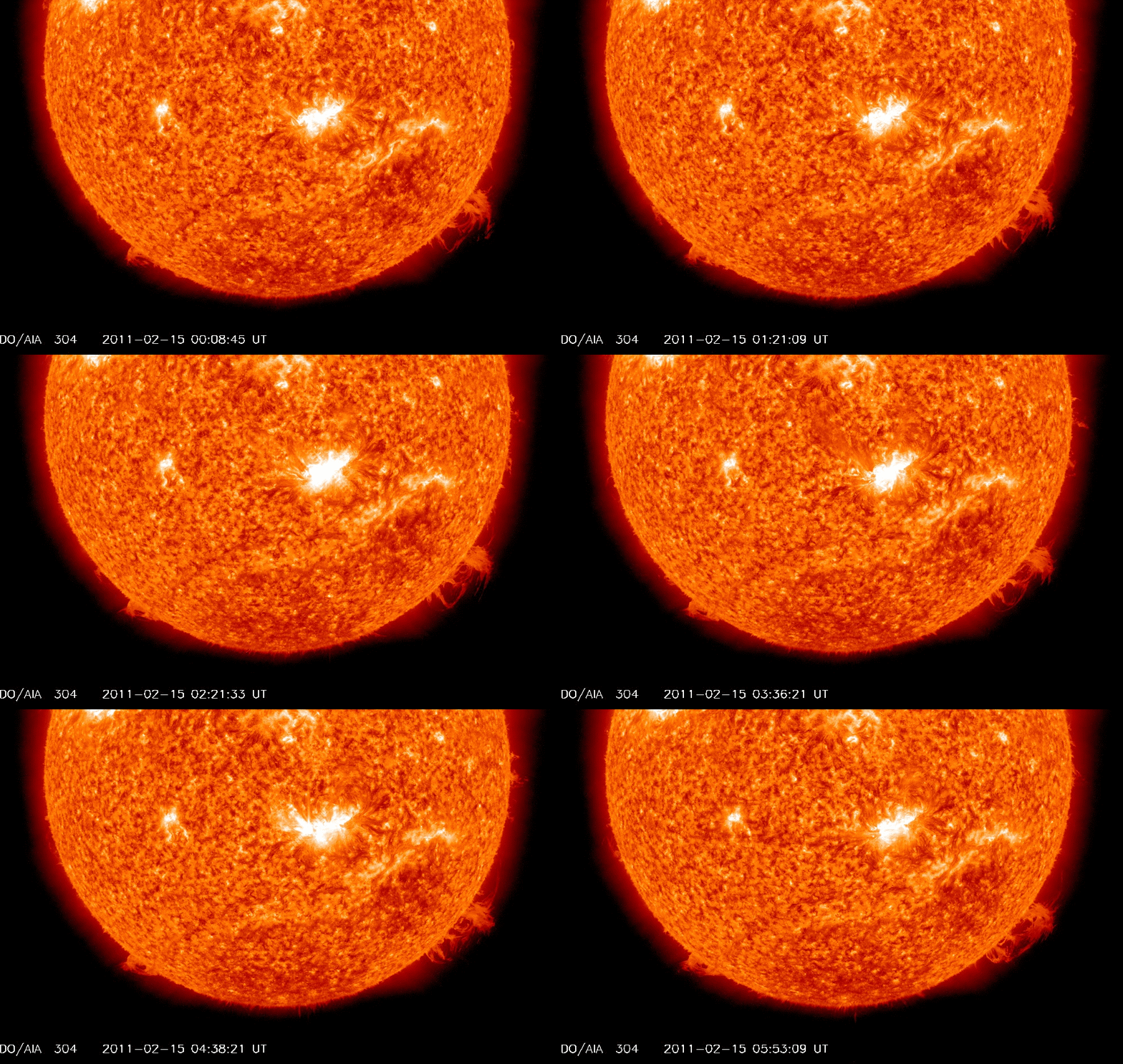
Sunspot 1158 has unleashed the strongest solar flare in more than four years. The eruption, which peaked at 0156 UT on Feb. 15th, registered X2 on the Richter scale of solar flares.
NASA's Solar Dynamics Observatory recorded an intense flash of extreme ultraviolet radiation.
movie formats: 5 MB gif, 1.3 MB iPad, 0.6 MB iPhone
X-flares are the strongest type of solar flare, and this is the first such eruption of new Solar Cycle 24. In addition to flashing Earth with UV radiation, the explosion also hurled a coronal mass ejection (CME) in our direction. The expanding cloud may be seen in this movie from NASA's STEREO-B spacecraft. Geomagnetic storms are possible when the CME arrives 36 to 48 hours hence. Stay tuned for updates.
This plasma filament above the Sun erupted as seen in this video by the Solar Dynamics Observatory. The eruption is in the upper right region of the solar disc. After it erupts, look to the left of center, at the top, for another plasma ejection. This view is at the 304-Angstrom and 193-Angstrom wavelengths. (Best viewed in Full Screen HD - full-screen)
The following video captures the massively large plasma filament 'erupion' from 12 December 2010.
A huge filament above the Sun erupted in an amazing display as seen in this video by the Solar Dynamics Observatory at approximately 1535 UTC (Dec 6, 2010). The eruption is in the lower left region of the solar disc, and you will see it toward the end of the video. This view is at the 304-Angstrom wavelength. (Best viewed in Full Screen HD - full-screen)
The next movie is of the Sun from Nov 15 to Dec 6 2010, as seen by SDO AIA at the 171 and 304 Angstrom wavelengths:
A rotation view of the full solar disc, as seen by the Solar Dynamics Observatory between November 15 and December 6, 2010. The view is a combination of the 171-Angstrom wavelength and 304-Angstrom wavelength filters of the SDO AIA instruments.
Notice the huge plasma "snakes" in the southern hemisphere (at several periods, including the very end of the rotation). These plasma filaments are incredibly large!
NASA's Solar Dynamics Observatory recorded an intense flash of extreme ultraviolet radiation.
movie formats: 5 MB gif, 1.3 MB iPad, 0.6 MB iPhone
X-flares are the strongest type of solar flare, and this is the first such eruption of new Solar Cycle 24. In addition to flashing Earth with UV radiation, the explosion also hurled a coronal mass ejection (CME) in our direction. The expanding cloud may be seen in this movie from NASA's STEREO-B spacecraft. Geomagnetic storms are possible when the CME arrives 36 to 48 hours hence. Stay tuned for updates.
This plasma filament above the Sun erupted as seen in this video by the Solar Dynamics Observatory. The eruption is in the upper right region of the solar disc. After it erupts, look to the left of center, at the top, for another plasma ejection. This view is at the 304-Angstrom and 193-Angstrom wavelengths. (Best viewed in Full Screen HD - full-screen)
The following video captures the massively large plasma filament 'erupion' from 12 December 2010.
A huge filament above the Sun erupted in an amazing display as seen in this video by the Solar Dynamics Observatory at approximately 1535 UTC (Dec 6, 2010). The eruption is in the lower left region of the solar disc, and you will see it toward the end of the video. This view is at the 304-Angstrom wavelength. (Best viewed in Full Screen HD - full-screen)
The next movie is of the Sun from Nov 15 to Dec 6 2010, as seen by SDO AIA at the 171 and 304 Angstrom wavelengths:
A rotation view of the full solar disc, as seen by the Solar Dynamics Observatory between November 15 and December 6, 2010. The view is a combination of the 171-Angstrom wavelength and 304-Angstrom wavelength filters of the SDO AIA instruments.
Notice the huge plasma "snakes" in the southern hemisphere (at several periods, including the very end of the rotation). These plasma filaments are incredibly large!
Subscribe to:
Posts (Atom)
My Stamp Collecting Blog

Counter Added January 1, 2011