The final Shuttle Launch (STS-135) is scheduled for launch tomorrow at 1526Z.
There will be two sister Special Events Stations operating for the Final Shuttle Launch.
Operations will begin five minutes after the launch (currently scheduled for 11:26 AM EST (1526Z)). If the launch is rescheduled, so will station operation.
Both stations will be offering a commemorative certificate or QSL card for the event. See the details of each station for QSL info.
Information for each station follows:
Special Events Station N4S (near the Cape in Florida) will be operating as follows:
CW 7.080, 14.050, 21.050 +/- 10kHz.
SSB 7.280, 14.280, 21.280 +/- 10kHz.
PSK 7.035, 14.070, 21.070
D-Star KJ4OXT
Cocoa repeater 145.190(-) PL 103.5
For a Certificate, send 8.5 x 11 S.A.S.E. to: North Brevard ARC, P O Box 1033, Mims FL 32754
Info: Bob Jones, N6USP, 4743 Cambridge Dr., Mims FL 32754 n6usp@bellsouth.net
Web site: North Brevard Amateur Radio Club: http://www.northbrevardarc.org/space...inallaunch.htm
Special Events Stations N5S (near White Sands Complex in New Mexico)
N5S will be operating SSB only on forty, twenty, and fifteen meters as band conditions permit.
For QSL, send S.A.S.E. to: N5S, P. O. Box 1443, Las Cruces, NM 88004-1433
Info: Mesilla Valley Radio Club (MVRC), N5BL, P. O. Box 1443, Las Cruces, NM 88004-1433
Web site: MVRC: http://www.n5bl.org
Tuesday, July 26, 2011
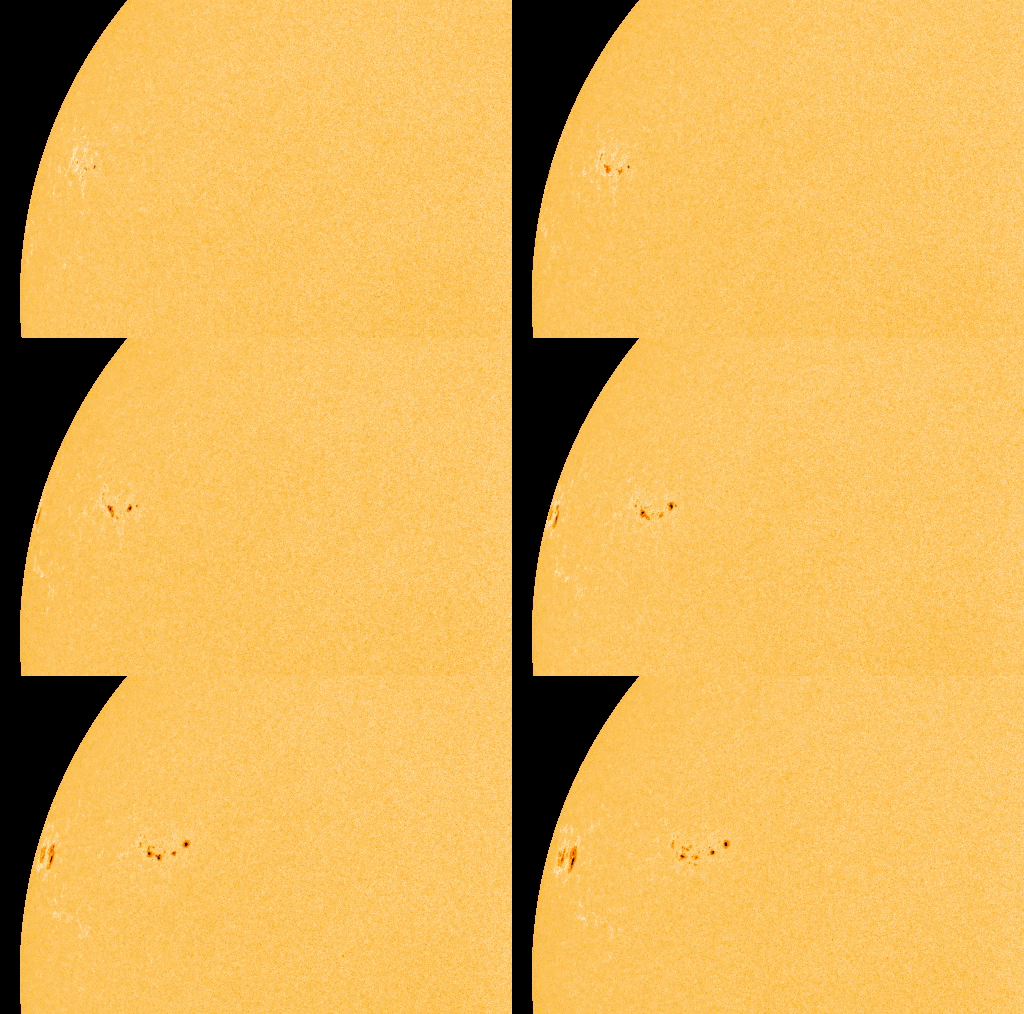
Sunspot Group AR1260
The leading sunspot group, AR1260, is crackling with C-class solar flares among a quartet of Earth-sized cores. Not far behind, sunspot AR1261 is larger and may harbor energy for flares of its own. At the moment, these two sunspot groups are too far off disk-center to affect Earth, but this will change in the days ahead.
Check out this short movie; click here
Saturday, July 23, 2011
Amateur Radio saves Man’s Life
Using the ham radio he was able to call friends on the air and his Automatic Packet Reporting System (APRS) provided a signal to track his position on a map
Read the Loudoun Times article at
http://www.loudountimes.com/index.ph..._mans_life111/
Automatic Packet Reporting System (APRS)
http://www.aprs.org/
The Intrepid-DX Group and the DX Friends have combined efforts to plan the multi-national DXpedition to Southern Sudan to celebrate the birth of a new country. ST0R will be active from July 22 to August 10.
The YouTube description reads
Southern Sudan 2011 DXpedition First Amateur Radio License issued by Southern Sudan Government South Sudan.
http://www.dxfriends.com/SouthernSudan2011/
W9IMS
W9IMS The Indianapolis Motor Speedway Amateur Radio Club
Brickyard 400 - July 25-31 & Red Bull Indianapolis GP - August 22-28:
We will operate from 1500Z through 0300Z on Friday, Saturday and Sunday of those two race weekends.
Friday, July 22, 2011
Articles of Interest & This Weekends Contest
ARRL Asks FCC to Keep 2300 MHz Proceeding Open
ISS crew to launch mini-satellite on August 3
Retransmission dates back to Apollo 11 days
These guys ham it up
Ham radio a calling for club aboard the USS Hornet
Aug 23, 1928
Some Doubt Expressed To Authenticity .Amateur Radio Operator Has ...
This Weekends Contest Opportunities
| NAQCC Straight Key/Bug Sprint | Jul 21 |
| RSGB 80m Club Championship, Data | Jul 21 |
| QRP Fox Hunt | Jul 22 |
| NCCC Sprint Ladder | Jul 22 |
| WAB 144 MHz QRO Phone | Jul 24 |
Thursday, July 21, 2011
Space Shuttle Atlantis; LAST RE-ENTRY:

The green band of light in the background is called "airglow." Airglow is a luminous bubble that surounds our entire planet, decorating the top of the atmosphere with aurora-like color. Although airglow resembles the aurora borealis, its underlying physics is different. Airglow is caused by an assortment of chemical reactions in the upper atmosphere driven mainly by solar ultraviolet radiation; auroras, on the other hand, are prompted by gusts of solar wind.
More pictures from the last flight of Atlantis may be found here.
Wednesday, July 20, 2011
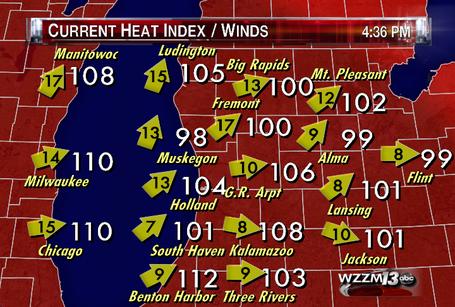
The 2011 Heat Wave
Stay cool all~
Tuesday, July 19, 2011
Loss of 2 Meter Simplex Frequencies
I am spreading the word~
Loss of two meter simplex frequencies IMMINENT in Texas!
Texas two meter simplex users stand to lose a large portion of available frequencies if proposed changes to the two meter band plan are passed by the Texas VHF-FM Society.In an effort to make room for D-Star repeater pairs, the Society has proposed a revised band plan that will take spectrum from two meter simplex users statewide.
Below is the band plan being proposed by the Texas VHF-FM Society:
146.450 - 146.490 MHz, High in/low out, 1 MHz offset, 12.5 kHz channel spacing or less, any
digital voice/data air interface technology suitable for the Amateur Radio Service that is compatible with the channel spacing. No analog transmission permitted.
145.520 Analog
145.540 Analog
145.560 Analog
145.580 Analog
145.600 Analog
145.620 Analog
145.640 Analog
145.660 Analog
145.680 Analog
145.700 Analog
145.720 Analog
145.740 Analog
145.760 Analog
145.780 Analog
146.420 Analog
146.440 Analog
146.450 Digital }
146.460 Digital }
146.470 Digital }--------------- Simplex allocations that will be lost due to proposed restructuring.
146.480 Digital }
146.490 Digital }
146.560 Analog
146.580 Analog
147.400 Analog
147.420 Analog
147.440 Analog
147.450 Digital }
147.460 Digital }
147.470 Digital }-------------- Simplex allocations that will be lost due to proposed restructuring.
147.480 Digital }
147.490 Digital }
147.560 Analog
147.580 Analog
This proposal was placed on the table at the March 1, 2008 General Meeting of the Texas VHF-FM Society and has yet to be voted on, possibly due to opposition from avid simplex users.
Contrary to public opinion, two meter simplex frequencies are regularly, and in some cases heavily used throughout the state.
A well-established group of simplex operators in north and east Texas have used the frequency of 147.420 on a daily basis since the mid 1970’s. While that frequency is not in immediate danger of being reallocated, other well used frequencies are!
A group of simplex operators around the Cedar Creek Lake area in eastern Texas that regularly use the frequency of 146.475 stands to lose that piece of spectrum.
146.500 is another frequency currently being used on a regular basis by hams from Dallas all the way down into the Waco area that is on the chopping block.
I’m sure there are many more frequencies all across the state that are in use that we do not know about! If anyone knows of other simplex frequencies in use in the state of Texas please feel free to e-mail me at WX5VHF@gmail.com
In an effort to display the utilization of these simplex frequencies I am asking for all Texas two meter simplex operators to attend and cast a vote at the Texas VHF-FM Society’s Summer Meeting that will take place at Austin Summerfest 2011. The meeting will be held Saturday, August 6th at 1:00PM in the Pecan Room of the Austin Marriott Airport South at 4415 South Interstate 35 in Austin.
In order to vote at this meeting you MUST be a member of the Society! To become a member you must download the form from the link below and send it back with $15.00. (I guess it’s sort of like a poll tax?)
http://www.txvhffm.com/images/Forms/...pplication.pdf
I believe I speak for most all avid simplex operators when I say, I am in no way anti D-Star. New technology and operating modes are the life blood of amateur radio. What I am against is reallocation of simplex spectrum as repeater pairs! D-star or analog, a repeater is a repeater and should be placed on frequencies that are already allocated for that purpose. If all of the repeater pairs are in use then get on the waiting list; just as analog repeater owners do. What is the rush?
Hams always say “Use it, or lose it” when it comes to radio spectrum. Well, this time it’s being used and we still may lose it!
Aaron Scott
WX5VHF
The Heat is On
So, here is what my weather is looking like for the next few days.
Heat advisory in effect from 10 am this morning to 8 pm edt this evening.
Early this morning. Partly cloudy. Light and variable winds.
Today. Mostly sunny. Highs in the mid 80s near lake Michigan and in the lower 90s inland. North winds around 5 mph becoming northwest late in the day. Heat index readings 94 to 99.
Tonight. Partly cloudy. Lows in the lower 70s. North winds 5 to 10 mph until midnight becoming light. Then becoming west around 5 mph toward daybreak.
Wednesday. Mostly sunny. Highs in the mid 80s near lake Michigan and in the mid 90s inland. Southwest winds 5 to 15 mph with gusts to around 25 mph. Heat index readings 100 to 105.
Wednesday night. Partly cloudy. Lows in the upper 70s. Southwest winds 10 to 15 mph.
Thursday. Mostly sunny. Highs in the mid 80s near lake michigan and in the mid 90s inland. Southwest winds 10 to 20 mph. Heat index readings 98 to 103.
Friday, July 15, 2011
This Weekends Contest
NCCC Sprint Jul 15
DMC RTTY Contest Jul 16-17
CWops Mini-CWT Test Jul 16-17
Feld Hell Sprint Jul 16
North American QSO Party, RTTY Jul 16-17
CQ Worldwide VHF Contest Jul 16-17
RSGB Low Power Contest Jul 17
CQC Great Colorado Gold Rush Jul 17
Run for the Bacon QRP Contest Jul 18
Friday, July 8, 2011
This Weekends Contest
| QRP Fox Hunt | Jul 8 |
| NCCC Sprint | Jul 8 |
| FISTS Summer Sprint | Jul 9 |
| IARU HF World Championship | Jul 9-10 |
| SKCC Weekend Sprint | Jul 10 |
| ARCI Summer Homebrew Sprint | Jul 10 |
| NAQCC-EU Monthly Sprint | Jul 11 |
Ham Radio; STS-135
Updated
America's Final Space Shuttle Launch
News Release Release Date:
For more information, contact:
Carl Zelich
Special Event Coordinator, The Final Launch
H. 407-977-5978 C. 407-687-8083
aa4mi@arrl.net
Amateur Radio in Action: The Final Launch
Chuluota, Florida, May 19, 2011 –
The Final Space Shuttle launch, STS-135 Atlantis, is currently scheduled for July 8!
An historic event, not to be missed, will soon occur. This will provide unprecedented photo and
media opportunities. More than 700.000 people will attend.
The Honorable Governor Rick Scott and family and Honorable Lt. Governor Jennifer Carroll and family, have been invited to visit our operating Amateur Radio Station.
Ham radio operators of Brevard County are invited to stop by our worldwide radio station to say a few words to Amateur Radio operators around the world.
Location: 1150 West King St., Cocoa FL 32922. This is on SR520 just west of U.S. 1.
"Ham radio has always been part of homeland defense and Amateur Radio operators have always acted to provide communications for their country," says Ray Kassis, N4LEM, ARES District Emergency Coordinator.
As a Special Event Station, a Special Call Sign will be issued by the Federal Communications Commission to commemorate this event.
We will be operating on:
CW 7.080, 14.050, 21.050 +/- 10kHz.
SSB 7.280, 14.280, 21.280 +/- 10kHz.
PSK 7.035, 14.070, 21.070
D-Star KJ4OXT
Cocoa repeater 145.190(-) PL 103.5
For a Certificate, send 8.5 x 11 S.A.S.E. to: North Brevard ARC, P O Box 1033, Mims FL 32754
Info: Bob Jones, N6USP, 4743 Cambridge Dr., Mims FL 32754 n6usp@bellsouth.net
Web site: North Brevard Amateur Radio Club: http://www.northbrevardarc.org/spaceshuttlefinallaunch.htm
To become involved in Amateur Radio, contact the ARRL, the national association for Amateur Radio, 225 Main StreetNewington, CT 06111 or 1-800-32-NEW HAM. ARRL home page: www.arrl.org
Wednesday, July 6, 2011
Movie SUPER 8 to feature Amateur Radio
A new movie, Super 8, set just outside Dayton, Ohio in 1979 uses Amateur Radio in a crucial scene.
Super 8 revolves around a group of six middle-schoolers who witnesses a mysterious train crash in the fictional town of Lillian. Soon after the crash, the Air Force arrives and strange things start happening in the small town.
The kids, a group of young film makers (hence the title of the movie) begin to investigate the creepy phenomena.
One of the kids’ dads is Deputy Lamb. After the Sherriff mysteriously disappears, Deputy Lamb takes over and holds a town-wide meeting to help allay the fear. One woman thinks that all the strange goings-on are the work of the Soviet Union. But when Deputy Lamb calls on Mr McCandless to ask a question, the man complains that he is hearing strange transmissions on his ham radio. As soon as Mr McCandless mentions ham radio, the residents at the meeting just ignore him.
Read the full ARRL story at
http://www.arrl.org/news/another-hollywood-blockbuster-
features-amateur-radio
Monday, July 4, 2011
Happy July 4, 2011

On this day in 1776 a group of 13 colonies broke away to found a new nation free to govern itself as it saw fit, pledging that each citizen would have the unalienable right to “life, liberty and the pursuit of happiness”. A nation, as Americans are apt to declare without equivocation, which became the greatest on the face of the earth. Happy July 4th my Family and Friends.
HOW TO READ PROPAGATION NUMBERS
The A index [ LOW is GOOD ]
- 1 to 6 is BEST
- 7 to 9 is OK
- 11 or more is BAD
Represents the overall geomagnetic condition of the ionosphere ("Ap" if averaged from the Kp-Index) (an average of the eight 3-hour K-Indices) ('A' referring to amplitude) over a given 24 hour period, ranging (linearly) typically from 1-100 but theoretically up to 400.
A lower A-Index generally suggests better propagation on the 10, 12, 15, 17, & 20 Meter Bands; a low & steady Ap-Index generally suggest good propagation on the 30, 40, 60, 80, & 160 Meter Bands.
SFI index [ HIGH is GOOD ]
- 70 NOT GOOD
- 80 GOOD
- 90 BETTER
- 100+ BEST
The measure of total radio emissions from the sun at 10.7cm (2800 MHz), on a scale of 60 (no sunspots) to 300, generally corresponding to the sunspot level, but being too low in energy to cause ionization, not related to the ionization level of the Ionosphere.
Higher Solar Flux generally suggests better propagation on the 10, 12, 15, 17, & 20 Meter Bands; Solar Flux rarely affects the 30, 40, 60, 80, & 160 Meter Bands.
K index [ LOW is GOOD ]
- 0 or 1 is BEST
- 2 is OK
- 3 or more is BAD
- 5 is VERY VERY BAD
The overall geomagnetic condition of the ionosphere ("Kp" if averaged over the planet) over the past 3 hours, measured by 13 magnetometers between 46 & 63 degrees of latitude, and ranging quasi-logarithmically from 0-9. Designed to detect solar particle radiation by its magnetic effect. A higher K-index generally means worse HF conditions.
A lower K-Index generally suggests better propagation on the 10, 12, 15, 17, & 20 Meter Bands; a low & steady Kp-Index generally suggest good propagation on the 30, 40, 60, 80, & 160 Meter Bands.
Terms of Service
I am not responsible for any thing that happens to your mental health, computer and all personal property because you visited my site.
This site is a collection of some things sent to me by e-mail, obtained from other blogs and the internet. If there is a picture or quote that is copyrighted to you let me know and I will remove your item .
Thoughts expressed in my blog are just that . I give My Opinion on the many events, products and how too, reported by the media and other web-sites.
Do not use this blog site to obtain weather events or disasters information. What I post may not be correct. Always get information from the proper media, weather (NWS)(NOAA)
Pacific Tsunami Warning Center and USGS sites