South Africa’s Defence Web reports that the nations second satellite, SumbandilaSat also known as SO-67 is no longer fully operational.
Rob Olivier is the head of Business Development at SunSpace. He told Defence Web that although contact can still be made with the satellite, it cannot capture images. As such it is no longer fulfilling its main purpose.
Oliver added that chances of repairing the satellite on-orbit are virtually none. As such SunSpace has moved on to other projects.
SumbandilaSat was damaged during a solar storm in the June of 2011.
The power supply to its onboard computer stopped working and the satellite stopped sending back images.
In addition to its primary mission SumbandilaSat also carried an radio payload as well. This consisted of a voice beacon, a store and forward parrot repeater and VHF to UHF FM repeater.
Thursday, February 2, 2012
Yaesu to Introduce New Digital Radios in 2012
Yaesu is hinting that they will be coming out with new digital amateur radios in 2012.
A new pamphlet discussing amateur digital radios shows the new Vertex Standard APCO P-25 commercial radios, as well as new amateur radios based on the C4FM FDMA digital audio system commonly known as MotoTrobo.
The pamphlet makes it appear that Yaesu will be offering amateur gear based on the MotoTrobo digital standard sometime this. The new vertex radios look identical to their Motorola counterparts.
Our guess is that any launch of such a project would likely take place at the Dayton Hamvention in mid-May.
A new pamphlet discussing amateur digital radios shows the new Vertex Standard APCO P-25 commercial radios, as well as new amateur radios based on the C4FM FDMA digital audio system commonly known as MotoTrobo.
The pamphlet makes it appear that Yaesu will be offering amateur gear based on the MotoTrobo digital standard sometime this. The new vertex radios look identical to their Motorola counterparts.
Our guess is that any launch of such a project would likely take place at the Dayton Hamvention in mid-May.

Wednesday, February 1, 2012
InnovAntennas have come to North America
InnovAntennas have come to North America. According to Bill Hein, AA7XT, the full line of high performance British built High Frequency, VHF and UHF amateur radio antennas from InnovAntennas are now available to customers across the United States at R&L Electronics in Hamilton, Ohio.
By way of background, InnovAntennas was launched in 2011 by Justin Johnson, G0KSC. This after his hobby of designing antennas for his personal use led to a flood of make one for me requests from amateur radio operators who recognized that Johnson’s designs outperformed they could buy in any U-K store.
Today, InnovAntennas is building antennas at a former boat factory in Canvey Island, England and selling its products directly via InnovAntennas.com and via a network of dealers in Europe, Australia, and now, the United States. Designs include the Loop Fed Array and Opposing Phase – Driven Element System Yagis both of which have become very popular in the world of Moonbounce or E-M-E operations.
For more information on the introduction of InnovAntennas to the United States ham radio marketplace, you can e-mail AA7XT to bill (at) innovantennas (dot) com. You can also check the R and L website at www.RandL.com.
By way of background, InnovAntennas was launched in 2011 by Justin Johnson, G0KSC. This after his hobby of designing antennas for his personal use led to a flood of make one for me requests from amateur radio operators who recognized that Johnson’s designs outperformed they could buy in any U-K store.
Today, InnovAntennas is building antennas at a former boat factory in Canvey Island, England and selling its products directly via InnovAntennas.com and via a network of dealers in Europe, Australia, and now, the United States. Designs include the Loop Fed Array and Opposing Phase – Driven Element System Yagis both of which have become very popular in the world of Moonbounce or E-M-E operations.
For more information on the introduction of InnovAntennas to the United States ham radio marketplace, you can e-mail AA7XT to bill (at) innovantennas (dot) com. You can also check the R and L website at www.RandL.com.
Tuesday, January 31, 2012
SEVHFS Soliciting Papers for April Conference
Papers and other presentations are solicited The 15th Annual Southeastern VHF Society Conference to be held in Charlotte, North Carolina on April 20th and 21st. Submissions are welcomed on both the technical and operational aspects of VHF, UHF and Microwave weak signal amateur radio. The deadline for the submission is February 17th.
More is on-line at www.svhfs.org.
More is on-line at www.svhfs.org.
LoTW to support CQ Operating Awards
CQ Communications and ARRL have signed an agreement to begin providing support for CQ-sponsored operating awards by the ARRL's Logbook of the World electronic confirmation system. CQ's awards will be the first non-ARRL awards supported by Logbook of the World and will be phased in, beginning with the CQ WPX award. Additional CQ awards will follow.
The target date for beginning Logbook of the World support for WPX is April 1st. Amateurs will be able to use Logbook of the World logs to generate lists of confirmed contacts to be submitted for WPX credit. Standard Logbook of the World credit fees and CQ award fees will apply.
The ARRL’s Logbook of the World system is an interactive database recording contacts between radio amateurs was created in 2003 and has been adopted by 47,500 radio amateurs worldwide. It already has records of 400 million contacts and grows weekly.
The agreement was announced jointly on Tuesday, January 24th by ARRL Chief Operating Officer Harold Kramer, WJ1B, and CQ Communications President Richard Ross, K2MGA
The target date for beginning Logbook of the World support for WPX is April 1st. Amateurs will be able to use Logbook of the World logs to generate lists of confirmed contacts to be submitted for WPX credit. Standard Logbook of the World credit fees and CQ award fees will apply.
The ARRL’s Logbook of the World system is an interactive database recording contacts between radio amateurs was created in 2003 and has been adopted by 47,500 radio amateurs worldwide. It already has records of 400 million contacts and grows weekly.
The agreement was announced jointly on Tuesday, January 24th by ARRL Chief Operating Officer Harold Kramer, WJ1B, and CQ Communications President Richard Ross, K2MGA
Monday, January 30, 2012
Emergency Email Launches FEMA Social Media Situation Page
Emergency Email & Wireless FEMA
Social Media Situation Page Links:
Situation Page announcement:
http://www.emergencyemail.org/newsemergency/anmviewer.asp?a=1718&z=34
FEMA Social Media Twitter FEEDS Situation Page
http://www.vuetoo.com/vue1/situationpagenews.asp?sit=7759
FEMA Social Media Situation Fusion Page 2
http://www.vuetoo.com/vue1/situationpagenews.asp?sit=7761
THE EMERGENCY EMAIL & WIRELESS NETWORK
www.EmergencyEmail.org
Social Media Situation Page Links:
Situation Page announcement:
http://www.emergencyemail.org/newsemergency/anmviewer.asp?a=1718&z=34
FEMA Social Media Twitter FEEDS Situation Page
http://www.vuetoo.com/vue1/situationpagenews.asp?sit=7759
FEMA Social Media Situation Fusion Page 2
http://www.vuetoo.com/vue1/situationpagenews.asp?sit=7761
THE EMERGENCY EMAIL & WIRELESS NETWORK
www.EmergencyEmail.org
Saturday, January 28, 2012
Anchorage VEC License Element Waiver Request
The FCC has turned away a request from Alaska’s Anchorage Volunteer Examination Coordinator for a temporary blanket waiver of Section 97.505(a) of the Commission’s Rules. This, to allow the VEC to give individuals whose amateur radio operator licenses have expired examination credit for test elements previously passed so that all former licensees could be re-licensed without retesting.
The Anchorage VEC had filed for the waiver pending the outcome of a related rulemaking petition in FCC Docket WT 11-130. That request seeks the same end but on a permanent nationwide basis.
But in its denial order the FCC noted that individuals who do not hold a current or renewable amateur radio operator license, regardless of whether they have held one in the past, must demonstrate their qualifications to be amateur radio operators before obtaining a new license. As such, the approval of the requested waiver to allow examination credit to be granted for any previously held amateur service operator license would not serve the underlying purpose of the regulatory agency’s licensing rules.
The FCC also stated that amateur radio testing opportunities are widely available. It said that Volunteer Examiner teams can administer tests at any location and time convenient to them and the examinee. As such Anchorage VEC has not shown that requiring retesting of examinees whose operator licenses expired more than two years ago, including those of advanced years, is inequitable or unduly burdensome, or that these examinees have no reasonable alternative.
But this matter is far from closed. In its conclusion the FCC also noted that the dismissal of the Anchorage VEC’s waiver request is a separate matter from the groups pending Rule Making request in FCC Docket WT 11-130. As such this action is without prejudice to Anchorage VEC’s pending rule-making petition.
The Report and Order denying the Anchorage VEC’s waiver request was issued on Tuesday, January 24th. As we go to air it’s not known if the Anchorage VEC will appeal this decision or simply wait for the outcome on its underlying Rule Making request.
The Anchorage VEC had filed for the waiver pending the outcome of a related rulemaking petition in FCC Docket WT 11-130. That request seeks the same end but on a permanent nationwide basis.
But in its denial order the FCC noted that individuals who do not hold a current or renewable amateur radio operator license, regardless of whether they have held one in the past, must demonstrate their qualifications to be amateur radio operators before obtaining a new license. As such, the approval of the requested waiver to allow examination credit to be granted for any previously held amateur service operator license would not serve the underlying purpose of the regulatory agency’s licensing rules.
The FCC also stated that amateur radio testing opportunities are widely available. It said that Volunteer Examiner teams can administer tests at any location and time convenient to them and the examinee. As such Anchorage VEC has not shown that requiring retesting of examinees whose operator licenses expired more than two years ago, including those of advanced years, is inequitable or unduly burdensome, or that these examinees have no reasonable alternative.
But this matter is far from closed. In its conclusion the FCC also noted that the dismissal of the Anchorage VEC’s waiver request is a separate matter from the groups pending Rule Making request in FCC Docket WT 11-130. As such this action is without prejudice to Anchorage VEC’s pending rule-making petition.
The Report and Order denying the Anchorage VEC’s waiver request was issued on Tuesday, January 24th. As we go to air it’s not known if the Anchorage VEC will appeal this decision or simply wait for the outcome on its underlying Rule Making request.
Friday, January 27, 2012
Interference from India Radio
Interference from All India Radio to the 40 meter band has been eliminated.
Wolfgang Hadel, DK2OM, in Siegbach, Germany, reports via the I-A-R-U Region 1 website that back last December 1st he and Peter Jost HB9CET of Zurich, Switzerland, noticed a band of white noise like interference on 40 meters. This from 6 dot 960 to 7 dot 040MHz and also on 7 dot 820 MHz and showing up every evening.
Calculation by DK2OM showed the center of the spurious emissions was expected to be on the center 7 dot 410 MHz. From this point the German and Swiss Departments of Post and Telecommunications became involved.
Both offices filed official complaints to their counterpart in India. VU2GMN assisted by filing a personal complaint. On January 13th the transmitter located near the city of New Delhi was reported as having been repaired, and all traces of this source of interference to 40 meters was gone.
Wolfgang Hadel, DK2OM, in Siegbach, Germany, reports via the I-A-R-U Region 1 website that back last December 1st he and Peter Jost HB9CET of Zurich, Switzerland, noticed a band of white noise like interference on 40 meters. This from 6 dot 960 to 7 dot 040MHz and also on 7 dot 820 MHz and showing up every evening.
Calculation by DK2OM showed the center of the spurious emissions was expected to be on the center 7 dot 410 MHz. From this point the German and Swiss Departments of Post and Telecommunications became involved.
Both offices filed official complaints to their counterpart in India. VU2GMN assisted by filing a personal complaint. On January 13th the transmitter located near the city of New Delhi was reported as having been repaired, and all traces of this source of interference to 40 meters was gone.
Thursday, January 26, 2012
SOPA & Amateur Radio
A follow up to last weeks story about the involvement of ham radio in halting the progress of two measures working their way through the U-S Congress. Laws that many say would have destroyed the Internet as we know it today.
While the giant QRZ dot com website took what could best be described as the amateur radio point position in helping to halt the twin bills in their tacks, it turns out that it was not alone. The Southgate News reports that at least two other ham radio websites took part in the protest. Both the amateur radio HF Link Forum and the APRS site aprs.fi were closed in the United States on Wednesday, January 18th.
The aprs.fi blog noted in advance that it would join Wikipedia and Reddit, and protest the proposed United States Stop Online Piracy or SOPA and the Protect Intellectual Property Act or PIPA legislation by closing down. The blog went on to note that if some APRS user were to post links to copyright infringing material, even when that material would reside somewhere other than aprs.fi itself, that aprs.fi could be shut down in the U.S. and there would not be much that the website owners could do about it.
As we go to air, both SOPA and PIPA have been withdrawn by their respective sponsors in Congress for retooling. That’s a fancy way of saying that enough votes had defected to make passage at this time impossible. At the same time it’s a way of keeping both pieces of legislation alive for re-introduction to the United States Federal law making process at some later date. And it’s a sure bet that content providers such as the motion picture and music industries which basically wrote these two pieces of legislation will try again.
While the giant QRZ dot com website took what could best be described as the amateur radio point position in helping to halt the twin bills in their tacks, it turns out that it was not alone. The Southgate News reports that at least two other ham radio websites took part in the protest. Both the amateur radio HF Link Forum and the APRS site aprs.fi were closed in the United States on Wednesday, January 18th.
The aprs.fi blog noted in advance that it would join Wikipedia and Reddit, and protest the proposed United States Stop Online Piracy or SOPA and the Protect Intellectual Property Act or PIPA legislation by closing down. The blog went on to note that if some APRS user were to post links to copyright infringing material, even when that material would reside somewhere other than aprs.fi itself, that aprs.fi could be shut down in the U.S. and there would not be much that the website owners could do about it.
As we go to air, both SOPA and PIPA have been withdrawn by their respective sponsors in Congress for retooling. That’s a fancy way of saying that enough votes had defected to make passage at this time impossible. At the same time it’s a way of keeping both pieces of legislation alive for re-introduction to the United States Federal law making process at some later date. And it’s a sure bet that content providers such as the motion picture and music industries which basically wrote these two pieces of legislation will try again.
Wednesday, January 25, 2012
TAPR & iQuadlabs Announce Agreement
Tucson Amateur Packet Radio and iQuadlabs have jointly announced a sourcing agreement for the open source Software Defined Radio or HPSDR boards. These are the ones best known by their nick-names of Magister, Mercury and Pennylane.
Under the new agreement, Tucson Amateur Packet Radio will acquire inventory of iQuadLabs creating a one-stop source for all open HPSDR boards. On the other side, iQuadLabs will gain the inventory from Tucson Amateur Packet Radio to build pre-configured and tested complete open HPSDR systems.
The end result will be that Tucson Amateur Packet Radio will have all open HPSDR boards in stock, in one place, for those wishing to buy boards, kits and components. And, for the first time in the history of open HPSDR, those who wish to by a completely assembled and tested radio will have a source at iQuadLabs. Zephyr Engineering, Inc will continue to manufacture the assembled boards. (TAPR)
Under the new agreement, Tucson Amateur Packet Radio will acquire inventory of iQuadLabs creating a one-stop source for all open HPSDR boards. On the other side, iQuadLabs will gain the inventory from Tucson Amateur Packet Radio to build pre-configured and tested complete open HPSDR systems.
The end result will be that Tucson Amateur Packet Radio will have all open HPSDR boards in stock, in one place, for those wishing to buy boards, kits and components. And, for the first time in the history of open HPSDR, those who wish to by a completely assembled and tested radio will have a source at iQuadLabs. Zephyr Engineering, Inc will continue to manufacture the assembled boards. (TAPR)
Friday, January 20, 2012
ARMY MARS RESUMES USE OF WINLINK 2000
The Army’s Military Auxiliary Radio System better known simply as Army MARS is back using WinLink 2000. The ARRL reports that Lieutenant General Susan Lawrence has reversed the decision to phase out the use of the global radio e-mail system by Army MARS members that was issued late last year.
Lieutenant General Lawrence stated that the Army, after reviewing its capabilities, had decided that the continued use of WinLink 2000 would be in MARS best interest. She went on to call it a valuable asset to Army MARS members and agencies that were using the service.
On January 5, 2012, the Chief of Army MARS officially notified the membership that the phase out notice had been rescinded. Army MARS members and agencies who had been using the service hailed the decision by Lieutenant General Lawrence and have resumed use of the WinLink 2000 radio e-mail system.
More about WinLink 2000 is on the web at www.winlink.org.
source ARRL
Lieutenant General Lawrence stated that the Army, after reviewing its capabilities, had decided that the continued use of WinLink 2000 would be in MARS best interest. She went on to call it a valuable asset to Army MARS members and agencies that were using the service.
On January 5, 2012, the Chief of Army MARS officially notified the membership that the phase out notice had been rescinded. Army MARS members and agencies who had been using the service hailed the decision by Lieutenant General Lawrence and have resumed use of the WinLink 2000 radio e-mail system.
More about WinLink 2000 is on the web at www.winlink.org.
source ARRL
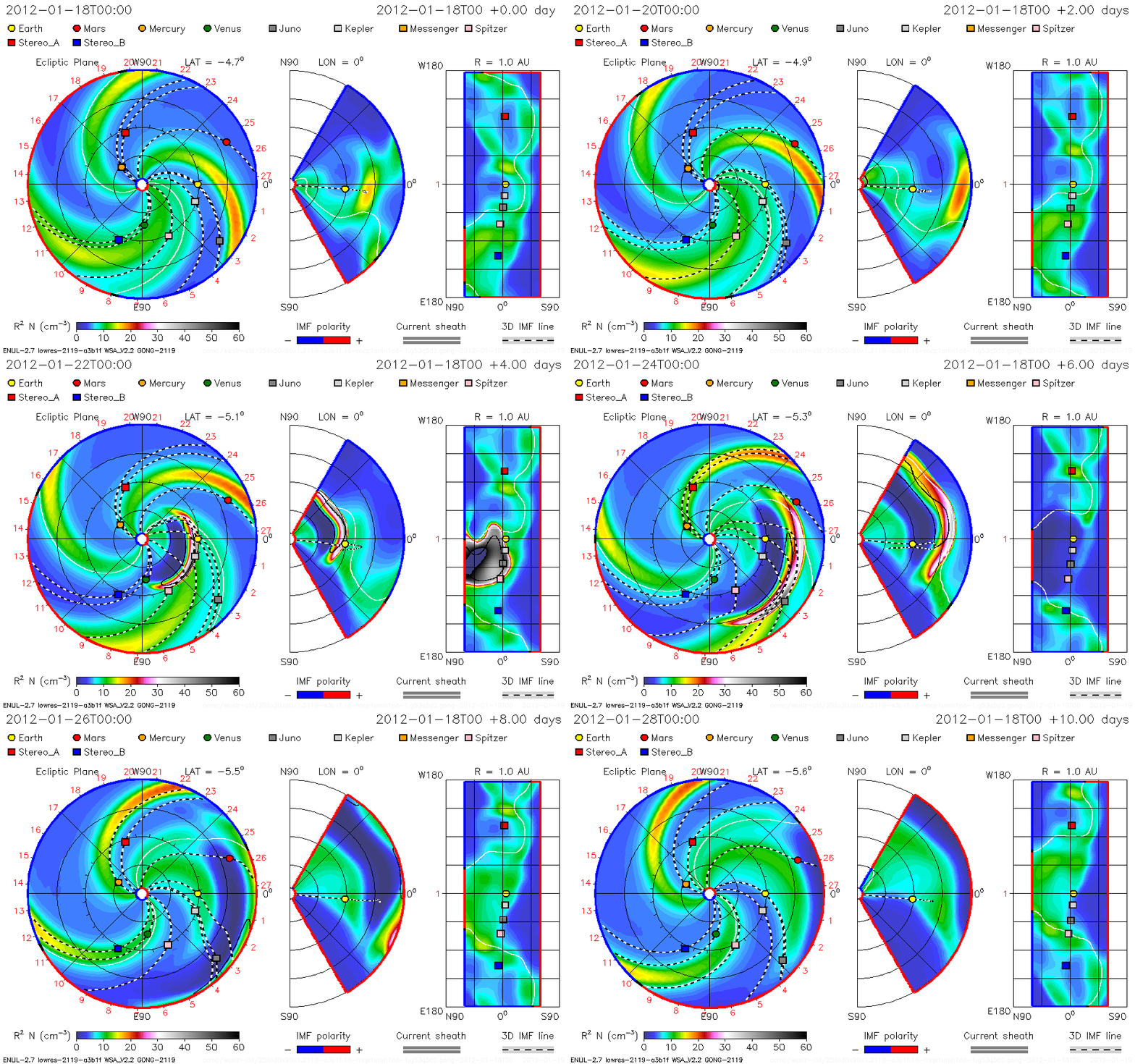
Earth-directed CME to Impact on Jan. 21, 2012
Active sunspot 1401 erupted yesterday, Jan. 19th around 16:30 UT, producing an M3-class solar flare and a full-halo coronal mass ejection (CME). The Solar and Heliospheric Observatory recorded the cloud expanding almost directly toward Earth:
Analysts at the Goddard Space Weather Lab say strong geomagnetic storms are possible when the cloud arrives this weekend. Their animated forecast track predicts an impact on Jan. 21st at 22:30 UT (+/- 7 hrs).
The cloud is also heading for Mars, due to hit the Red Planet on Jan. 24th. NASA's Curiosity rover, en route to Mars now, is equipped to study solar storms and might be able to detect a change in the energetic particle environment when the CME passes by.
Analysts at the Goddard Space Weather Lab say strong geomagnetic storms are possible when the cloud arrives this weekend. Their animated forecast track predicts an impact on Jan. 21st at 22:30 UT (+/- 7 hrs).
The cloud is also heading for Mars, due to hit the Red Planet on Jan. 24th. NASA's Curiosity rover, en route to Mars now, is equipped to study solar storms and might be able to detect a change in the energetic particle environment when the CME passes by.
Wednesday, January 18, 2012
WINMOR--A New HF Digital Protocol for Winlink 2000

WINMOR stands for WINlink Message Over Radio and is a new HF radio transmission protocol by Rick Muething, KN6KB, of the Winlink Development Team. WINMOR was introduced at the 2008 ARRL / TAPR Digital Communications Conference in Chicago on September 26-28, 2008, and released from beta testing to production versions in 2010. Unlike PACTOR, only a simple computer soundcard-to-radio interface is required, and it runs as a “virtual TNC” (the WINMOR TNC application) together with host software. The protocol (not the software) is fully documented and is without restrictions or license issues which might prevent anyone from implementing the protocol in other software. The WINMOR TNC software is also fully documented as an API for developers. The software TNC can freely distributed when paired with a developer’s own host application software.
PACTOR vs. WINMOR
Users may employ either WINMOR or Pactor to transfer mail in the WL2K system, depending on their equipment. While WINMOR may not equal P2 and P3 in total performance, it provides a cost-effective means of using the system, and is more robust and faster than P1, and faster than P2 in favorable conditions. WINMOR is attractive to anyone who has trouble justifying the high cost and low utilization of a P2 and P3 modem. Cruisers, who daily use radio email for long-distance lifeline communications at sea, can usually justify the P3 modem purchase. EmComm agencies who fund equipment purchases usually are smart to opt for P3 modems for reliability and ease of use under the stress of emergency operations. Successful WINMOR soundcard operating requires skill in making multiple adjustments, and knowledge of the computer’s operating system, which often do not lend themselves to success under the pressure of an emergency situation.
RMS Express with WINMOR for Users
See the User Software page for more information and to download the RMS Express client software, which includes the virtual WINMOR TNC software, and additionally supports Pactor 1-3, AX.25 packet and Telnet protocols using a wide variety of TNCs and multimode controllers.
WINMOR TNC Software for Developers
WINMOR TNC is a Windows “helper application” that creates a virtual WINMOR HF MODEM (TNC) using a standard PC sound card. It is intended to be used by developers who create complete end user Client or Server host applications. Example of such programs are RMS Express (Radio client) and RMS WINMOR (Radio Server).
The WINMOR TNC software license is provided in the help files of the downloaded program, and is not in the public domain. Please see these files for details.
Use this link: Download WINMOR TNC
Documentation Link
Tuesday, January 17, 2012
RIGrunner 4005i

The RIGrunner 4005i enables amateur radio, emergency communications systems and repeater site operators to monitor and control their DC power distribution systems from any internet-ready mobile device or PC.
Features Provides internet based monitoring and control of 12 VDC power distribution
Delivers up to 40 amps total through 5 outlets while transmitting, 30 amps continuous duty
Each outlet features independent on/off control and user configurable current trip point, 1A to 40A
RJ45 Ethernet port standard, WiFi option available
Integrated web server for monitoring and control
Can be configured to issue alarm email when outlet trips off
Front mounted LCD display and indicator LEDs for local monitoring of status, input voltage and current draw from each outlet
Rear mounted Anderson Powerpole® connectors with locking clips
Low profile for 1U 19″ rack or horizontal shelf mounting option
Rack mounted version custom built to order, contact West Mountain Radio for details.
Includes in all Models
(4) Rubber Feet
(4) 3M Adhesive Pads
(1) 6-pair pack of 30A Powerpole connectors
(6) Retention Clips
RJ45 Ethernet Cable
Owner’s Manual
Rack Mounted Model
1U 19″ Rack Bracket and Faceplate
WiFi add-on module with antenna
Software
The integrated web server enables internet based monitoring and control of your DC power distribution system. It includes the following capabilities:
Input voltage monitor
Current draw monitoring through each outlet
Individual outlet on/off control with trip indication
Configuration of current limits for each outlet, 1 to 40 amps
Generation of alarm email in case of current limit trip
RIGrunner 4005i Owner’s Manual
Price: $279.95 USD
Sunday, January 15, 2012
Pure Michigan in January
Here's what's happening in Michigan next month.
Your trip begins at michigan.org.
Auto Showcase Takes Center Stage in Detroit
See the most innovative auto designs in the world as more than 500 vehicles debut at North America's largest and most prestigious automotive showcase. Read More
Culinary Destinations Make Great Winter Getaways
Escape into a world of wine, food and fun this winter with a delightful Michigan culinary excursion. From festivals to cooking classes, every foodie is sure to find something to satisfy their appetite. Read More
Snowshoe Hikes and Lantern-Lit Winter Fun
Looking for another great winter family adventure? Michigan state parks are groomed and ready--day and night--with fun activities at an affordable cost. Read More
UP Slope Patrol
Head to Michigan's western Upper Peninsula for your next ski getaway and experience top notch resorts with all of the amenities that cater to avid downhill ski enthusiasts. Read More
Winter Events Buzz
From concept cars to sled-dog races, from ice festivals to ski jumping competitions and great museum exhibits-- Michigan stages unforgettable events all through the month of January. Read More

source
Your trip begins at michigan.org.
Auto Showcase Takes Center Stage in Detroit
See the most innovative auto designs in the world as more than 500 vehicles debut at North America's largest and most prestigious automotive showcase. Read More
Culinary Destinations Make Great Winter Getaways
Escape into a world of wine, food and fun this winter with a delightful Michigan culinary excursion. From festivals to cooking classes, every foodie is sure to find something to satisfy their appetite. Read More
Snowshoe Hikes and Lantern-Lit Winter Fun
Looking for another great winter family adventure? Michigan state parks are groomed and ready--day and night--with fun activities at an affordable cost. Read More
UP Slope Patrol
Head to Michigan's western Upper Peninsula for your next ski getaway and experience top notch resorts with all of the amenities that cater to avid downhill ski enthusiasts. Read More
Winter Events Buzz
From concept cars to sled-dog races, from ice festivals to ski jumping competitions and great museum exhibits-- Michigan stages unforgettable events all through the month of January. Read More
source
Subscribe to:
Posts (Atom)
My Stamp Collecting Blog

Counter Added January 1, 2011