Almost every measure of solar activity flatlined over the weekend.
The event, though not unprecedented, is odd considering that our local
star has just passed what is supposed to be the peak of its solar cycle,
when activity is at its highest.
“It really underscores this solar cycle playing out as being pretty
benign,” said Robert Rutledge, lead of the forecast office at the NOAA/National Weather Service Space Weather Prediction Center.
“This has been by any measure a really pretty quiet cycle, and I think
we shouldn’t expect the second half to be any different.”
To Read More; Click Here
http://www.wired.com/wiredscience/2013/09/sun-all-quiet/
Showing posts with label Sun. Show all posts
Showing posts with label Sun. Show all posts
Tuesday, September 17, 2013
Wednesday, March 6, 2013
Peak of Cycle 24
Something unexpected appears to be happening on the sun.
2013 is supposed to be the year of Solar Max also known as
the peak of Cycle 24.  Yet 2013 has arrived and solar
activity is relatively low.  Sunspot numbers are well below
their values in 2011, and strong solar flares have been
infrequent for many months.  The quiet has led some
observers to wonder if forecasters missed the mark.

Dean Pesnell is a Solar physicist at the Goddard Space
Flight Centre in Greenbelt, Maryland.  He suggests that this
is the solar maximum, but it looks different from what we
expected because it will be double peaked.

Conventional wisdom holds that solar activity swings back
and forth like a simple pendulum.  At one end of the cycle,
there is a quiet time with few sunspots and flares.  At the
other end, the Solar Max brings high sunspot numbers and
solar storms with a regular rhythm that repeats every 11
years.

Reality, however, is more complicated.  Astronomers have
been counting sunspots for centuries, and they have seen
that the solar cycle is not perfectly regular.  For one
thing, the back-and-forth swing in sunspot counts can take
anywhere from 10 to 13 years to complete.  Also, the
amplitude of the cycle varies.  Some solar maxima are very
weak while others can be very strong.

And as researcher Pesnell notes, there is yet another
complication.  He says that the last two solar maxima,
around 1989 and 2001, had not one but two peaks.  He says
that solar activity went up, dipped, and then resumed while
performing a mini-cycle within the Solar Max that lasted
about two years.

Pesnell says that the same thing could be happening now.  He
notes that sunspot counts jumped in 2011 and dipped in 2012.
As such, he expects them to rebound again saying that
another peak will happen in 2013 and possibly last into
2014.  Lets hope he is right.

Monday, April 23, 2012
Geomagnetic Storm Watch
A minor (Kp=5) geomagnetic
storm is underway.
This is probably due to Earth's passage through
the wake of a CME that swept past our planet earlier
today.
Threshold Reached: 2012 Apr 24 0046 UTC
Synoptic Period: 0000-0300 UTC
Active Warning: Yes
NOAA Scale: G2 - Moderate
Potential Impacts: Area of impact primarily poleward of 55 degrees Geomagnetic Latitude.
Induced Currents - Power grid fluctuations can occur. High-latitude power systems may experience voltage alarms.
Spacecraft - Satellite orientation irregularities may occur; increased drag on low Earth-orbit satellites is possible.
Radio - HF (high frequency) radio propagation can fade at higher latitudes.
Aurora - Aurora may be seen as low as New York to Wisconsin to Washington state.
ALERT: Geomagnetic K-index of 6
Threshold Reached: 2012 Apr 24 0046 UTC
Synoptic Period: 0000-0300 UTC
Active Warning: Yes
NOAA Scale: G2 - Moderate
Potential Impacts: Area of impact primarily poleward of 55 degrees Geomagnetic Latitude.
Induced Currents - Power grid fluctuations can occur. High-latitude power systems may experience voltage alarms.
Spacecraft - Satellite orientation irregularities may occur; increased drag on low Earth-orbit satellites is possible.
Radio - HF (high frequency) radio propagation can fade at higher latitudes.
Aurora - Aurora may be seen as low as New York to Wisconsin to Washington state.
Friday, January 20, 2012
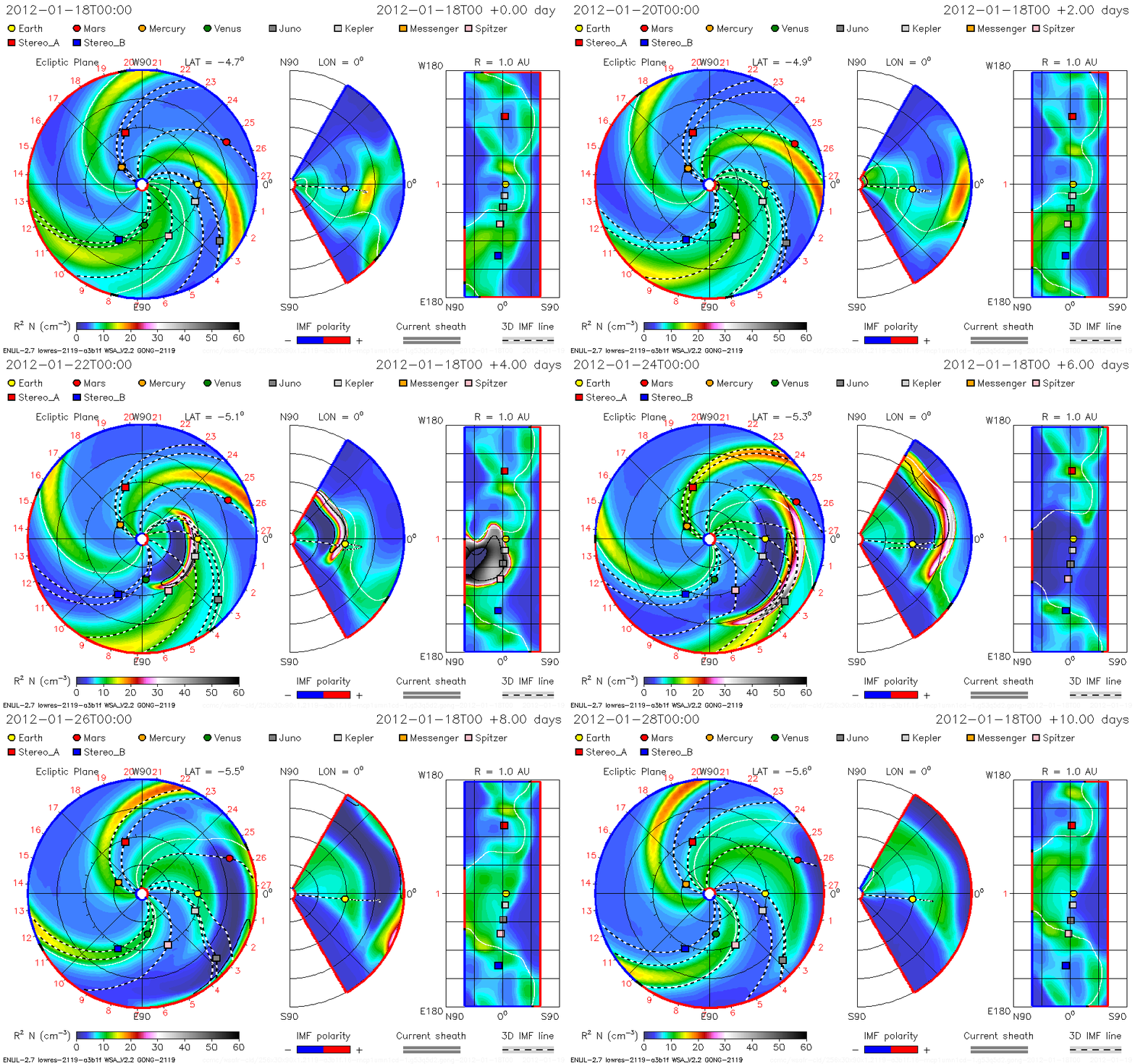
Earth-directed CME to Impact on Jan. 21, 2012
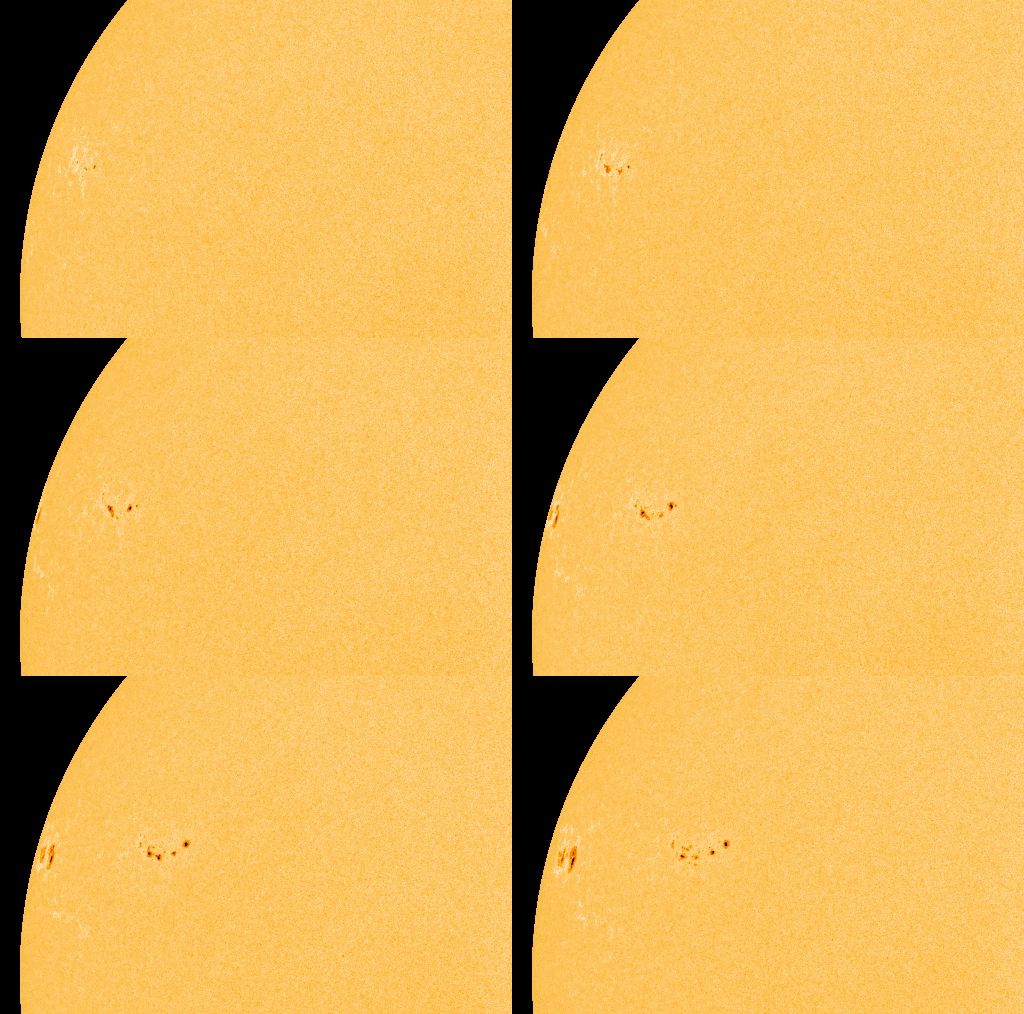
Active sunspot 1401 erupted yesterday, Jan. 19th around 16:30 UT, producing an M3-class solar flare and a full-halo coronal mass ejection (CME). The Solar and Heliospheric Observatory recorded the cloud expanding almost directly toward Earth:
Analysts at the Goddard Space Weather Lab say strong geomagnetic storms are possible when the cloud arrives this weekend. Their animated forecast track predicts an impact on Jan. 21st at 22:30 UT (+/- 7 hrs).
The cloud is also heading for Mars, due to hit the Red Planet on Jan. 24th. NASA's Curiosity rover, en route to Mars now, is equipped to study solar storms and might be able to detect a change in the energetic particle environment when the CME passes by.
Analysts at the Goddard Space Weather Lab say strong geomagnetic storms are possible when the cloud arrives this weekend. Their animated forecast track predicts an impact on Jan. 21st at 22:30 UT (+/- 7 hrs).
The cloud is also heading for Mars, due to hit the Red Planet on Jan. 24th. NASA's Curiosity rover, en route to Mars now, is equipped to study solar storms and might be able to detect a change in the energetic particle environment when the CME passes by.
Saturday, September 10, 2011
GEOMAGNETIC STORM
GEOMAGNETIC STORM: A CME hit Earth's magnetic field on Sept. 9th, and the impact ignited a geomagnetic storm, in progress. Northern Lights have since been spotted in the United States as far south as as Michigan, Montana and North Dakota. This could be the first of several hits from a series of CMEs expected to reach Earth during the weekend, so more geomagnetic activity is in the offing~
Remember, Geomagnetic storms can cause difficulties in communicating over long distances
Many communication systems utilize the ionosphere to reflect radio signals over long distances. Ionospheric storms can affect radio communication at all latitudes. Some radio frequencies are absorbed and others are reflected, leading to rapidly fluctuating signals and unexpected propagation paths. TV and commercial radio stations are little affected by solar activity, but ground-to-air, ship-to-shore, Voice of America, Radio Free Europe, and amateur radio are frequently disrupted. Radio operators using high frequencies rely upon solar and geomagnetic alerts to keep their communication circuits up and running.
Some military detection or early-warning systems are also affected by solar activity. The Over-the-Horizon Radar bounces signals off the ionosphere in order to monitor the launch of aircraft and missiles from long distances. During geomagnetic storms, this system can be severely hampered by radio clutter. Some submarine detection systems use the magnetic signatures of submarines as one input to their locating schemes. Geomagnetic storms can mask and distort these signals.
More info; http://www.arrl.org/news/the-k7ra-solar-update-181
Tuesday, August 9, 2011
Massive X6.9 Class Solar Flare
August 9, 2011 - The largest flare of the solar cycle, an R3 (Strong) Radio Blackout, alternatively classified as an X6, occurred today at 0805Z. Region 1263, now poised near the west limb, produced the event and a few others of lesser magnitude in the past day. The region remains hot at this writing.
A quick rise in the protons at GOES reached S1 (Minor) levels soon after the eruption. Given the location of the activity, any CMEs would likely be directed away from Earth so no significant Geomagnetic Storm activity is forecast.
*Solar Storms May Disrupt Gadgets
*Power companies prepare as solar storms set to hit Earth
Tuesday, July 26, 2011
Sunspot Group AR1260
After more than a week of quiet, solar activity is picking up. NASA's Solar Dynamics Observatory is monitoring two big sunspot groups now emerging over the sun's eastern limb.
The leading sunspot group, AR1260, is crackling with C-class solar flares among a quartet of Earth-sized cores. Not far behind, sunspot AR1261 is larger and may harbor energy for flares of its own. At the moment, these two sunspot groups are too far off disk-center to affect Earth, but this will change in the days ahead.
Check out this short movie; click here
The leading sunspot group, AR1260, is crackling with C-class solar flares among a quartet of Earth-sized cores. Not far behind, sunspot AR1261 is larger and may harbor energy for flares of its own. At the moment, these two sunspot groups are too far off disk-center to affect Earth, but this will change in the days ahead.
Check out this short movie; click here
Thursday, June 16, 2011
Chance of Solar Flares
The magnetic field of sunspot 1236 harbors energy for M-class solar flares. NOAA forecasters estimate a 25% chance of such an eruption during the next 24 hrs.
Thursday, June 9, 2011
Geomagnetic Storm Warning Downgraded
NOAA forecasters have downgraded the chances of a geomagnetic storm on June 9th to 20%. The disturbance, if it occurs, would be in response to a glancing blow from the CME of June 7th.
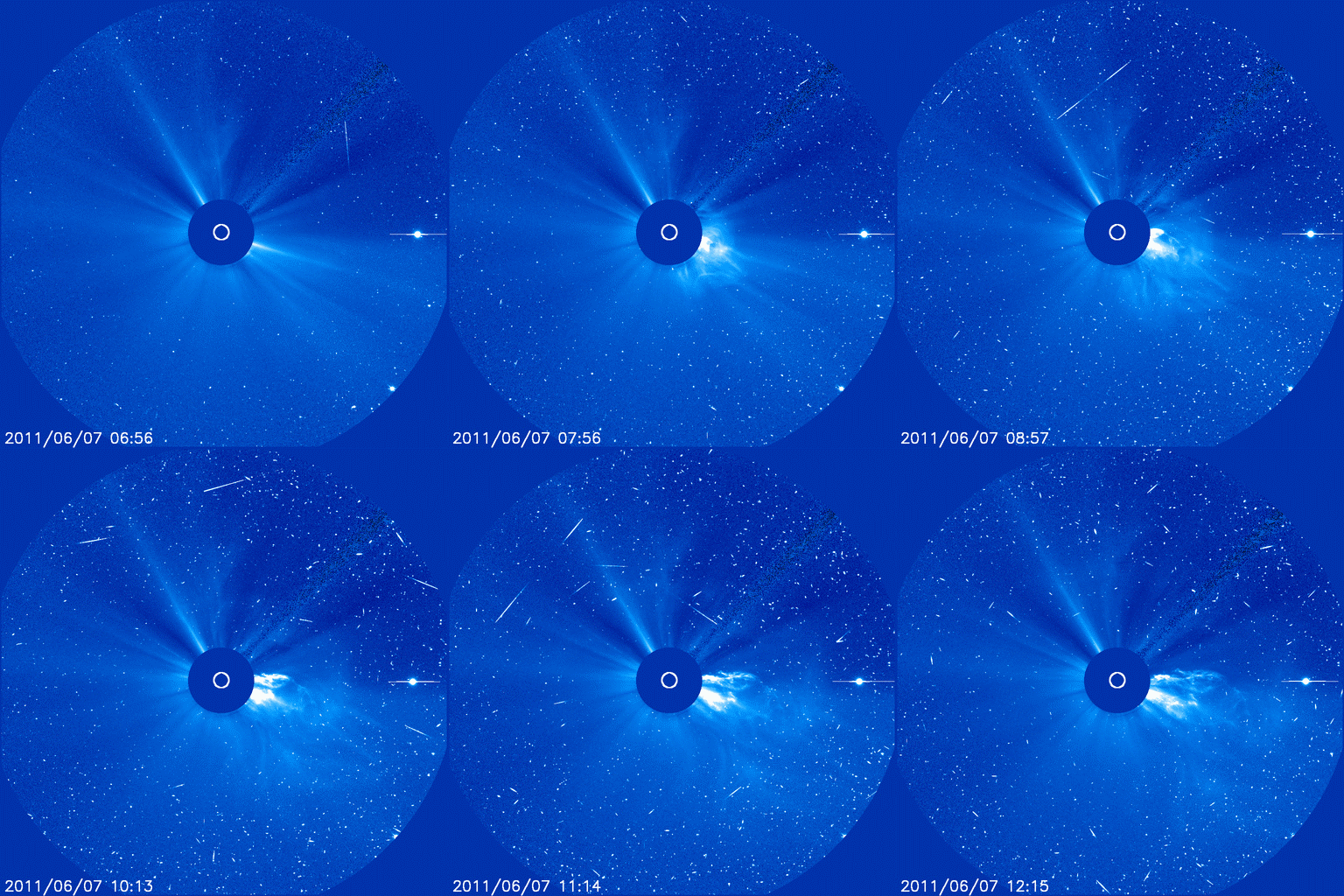
On June 7th at 0641 UT, magnetic fields above sunspot complex 1226-1227 became unstable and erupted. The resulting blast produced an M2-class solar flare, an S1-class radiation storm, and an unbelievable movie:
On June 7th at 0641 UT, magnetic fields above sunspot complex 1226-1227 became unstable and erupted. The resulting blast produced an M2-class solar flare, an S1-class radiation storm, and an unbelievable movie:
"It looks like someone kicked a clod of dirt in the air," says solar physicist C. Alex Young of NASA's Goddard Space Flight Center in a Youtube video. "I've never seen material released in this way before--an amazing, amazing event."
Much of the plasma thrown up by the blast simply fell back to the sun--indeed, that's what makes the footage so dramatic. In the movies you can see blobs of hot gas as large as Earth making bright splashes where they hit the stellar surface. Some plasma, however, reached escape velocity and left the sun in the form of a coronal mass ejection: movie. Traveling faster than 1100 km/s, the CME should deliver a glancing blow to Earth's magnetic field on June 9th. High-latitude sky watchers should be alert for auroras when the CME arrives.
Credit: NASA's Solar Dynamics Observatory.
Saturday, June 4, 2011
MAGNETIC STORMS on June 4th
NOAA forecasters estimate a 45% chance of geomagnetic activity on June 4th when an incoming solar wind stream and a CME might deliver a double blow to Earth's magnetic field.
Tuesday, April 26, 2011
B-Class Eruption
'B' STANDS FOR ... BORING? On the Richter Scale of solar flares, B-class eruptions are weak and generally considered boring. Really? Consider the following B-class eruption recorded by NASA's Solar Dynamics Observatory (SDO) on April 23rd.
That wasn't boring. On the contrary, the blast hurled hundreds of thousands of tons of plasma above the stellar surface with a power akin to millions of atomic bombs. The only thing more amazing than the blast was its aftermath. For all that power, the explosion was insufficient to break the plasma free from the sun's grasp. Magnetic fields arcing above underlying sunspot 1193 held tight to the expanding gas and pulled it back down with a dynamic double bounce.
One of the most significant findings from SDO, barely a year after First Light, is that there are no truly boring solar flares. The observatory's Hubble-like cameras have revealed hidden power and fascination in even the smallest eruptions, leaving us waiting with anticipation for the next B-flare. Stay tuned.
source
Wednesday, April 13, 2011
Geomagnetic Storm Update
A geomagnetic storm that sparked auroras around the Arctic Circle and sent Northern Lights spilling over the Canadian border into the United States on April 12th is subsiding.
Tuesday, April 12, 2011
GEOMAGNETIC STORM
A G1-class geomagnetic storm is in progress, sparked by a high-speed solar wind stream which is buffeting Earth's magnetic field.
To read more, Click Here
To read more, Click Here
Saturday, April 9, 2011
CME on the way?
Newly-arriving data from NASA's STEREO probes suggest that a coronal mass ejection (CME) might be heading toward Earth. The source of the cloud appears to be sunspot complex 1185-1186, which experienced an episode of magnetic instability during the early hours of April 9th. Stay tuned for updates to this preliminary analysis.
CME movies: STEREO-A, STEREO-B.
source
CME movies: STEREO-A, STEREO-B.
source
Tuesday, March 22, 2011
BIG Trouble on the Way?


A big sunspot is emerging over the sun's southeastern limb, and it is crackling with activity. NASA's Solar Dynamics Observatory recorded a surge of extreme ultraviolet radiation from the sunspot's magnetic canopy on March 21st.
This appears to be the return of old sunspot 1165, last seen in early March when it formed on the sun's southwestern limb. Since then it has been transiting the far side of the sun, apparently growing in size and restlessness. The potential for trouble will become more clear in the hours ahead as the active region emerges in full. Stay tuned.
Monday, March 21, 2011
PRESTO ALERT
Rare event 03 21 2011 0957 UTC: Proton flux increased; storm threshold not reached. Back-sided plasma cloud came into view of STEREO B COR2 @ 0254 UTC maybe associated w/proton levels. Earth is magnetically connected w/source site behind Sun. Parker spiral has bended magnetic field lines that guide the electrically charged protons. Earth is near such field lines along which these protons travel. This is a rare event.
SIDC - Solar Influences Data Analysis Center - Homepage
PRESTO Alert
SIDC - Solar Influences Data Analysis Center - Homepage
PRESTO Alert
Saturday, March 19, 2011
Big Eruption on the Sun 3/19/11

ICONIC ERUPTION: A huge filament of magnetism and hot plasma blasted off the sun's southwestern limb on March 19th around 1200 UT. NASA's Solar Dynamics Observatory recorded the action.
The eruption was not Earth-directed, but it did attract plenty of attention on our planet. Many amateur astronomers in Europe witnessed the blast and said it was the biggest one they'd ever seen. This event continues the recent trend of increasing solar activity, and shows anew that Solar Cycle 24 is gaining steam after a long period of relative quiet.
source
Friday, February 25, 2011
Monster Solar Prominence Captured by SDO

The Sun continues to be active! A large-sized (M 3.6 class) flare occurred near the edge of the Sun on February 24, 2011, and it blew out a gorgeous, waving mass of erupting plasma that swirled and twisted over a 90-minute period. This event was captured in extreme ultraviolet light by NASA’s Solar Dynamics Observatory spacecraft. Some of the material blew out into space and other portions fell back to the surface. Because SDO images are super-HD, the scienctists can zoom in on the action and still see exquisite details. The video above was created using a cadence of a frame taken every 24 seconds; still, the sense of motion is, by all appearances, seamless. Sit back and enjoy the jaw-dropping solar show. See one of the images, below.
Spaceweather.com reports that Earth was little affected by this blast, as plasma clouds produced by the blast did not come our way.
The latest active sunspot — #1163 — is currently behind the Sun’s eastern limb, but be turning toward Earth in the days ahead, setting the stage for more activity if the eruptions continue.A Video for you to check out as well.
Thursday, February 17, 2011
CME Update
IMPACT!
A CME hit Earth's magnetic field at approximately 0100 UT on Feb. 18th (8:00 pm EST on Feb. 17th). The impact was not as strong as expected considering the cloud's probable X-class origin. Nevertheless, geomagnetic storms are possible in the hours ahead. High-latitude sky watchers should be alert for auroras.
Source; find more here
A CME hit Earth's magnetic field at approximately 0100 UT on Feb. 18th (8:00 pm EST on Feb. 17th). The impact was not as strong as expected considering the cloud's probable X-class origin. Nevertheless, geomagnetic storms are possible in the hours ahead. High-latitude sky watchers should be alert for auroras.
Source; find more here
Solar Flare Headed For Earth
Here it comes, this should make DXing fun.
Biggest Solar Flare in Years Headed Towards Earth
The calm before the storm. Three CMEs are enroute, all a part of the Radio Blackout events on February 13, 14, and 15 (UTC). The last of the three seems to be the fastest and may catch both of the forerunners about mid to late day tomorrow, February 17. Watch this space for updates on the impending -- G2, possibly periods of G3 -- geomagnetic storming.
source 2
Biggest Solar Flare in Years Headed Towards Earth
The calm before the storm. Three CMEs are enroute, all a part of the Radio Blackout events on February 13, 14, and 15 (UTC). The last of the three seems to be the fastest and may catch both of the forerunners about mid to late day tomorrow, February 17. Watch this space for updates on the impending -- G2, possibly periods of G3 -- geomagnetic storming.
Watch Today's Space Weather for the most recent activity.
Among the many potential disasters that can come from a massive CME: disturbances in the planet’s geomagnetic field that may lead to malfunctioning telecom and GPS satellite equipment.
While forecasters predict no major impact on our telecommunications infrastructure, scientists have pointed out the sun is now ramping up ahead of an expected solar maximum around 2013.
source 1source 2
Subscribe to:
Posts (Atom)
My Stamp Collecting Blog