Thursday, November 25, 2010
Tuesday, November 23, 2010
BETA ANGLE
I was on a net and we were talking about Satellites, ISS and the Space Shuttle. The topic came up about the Beta Angle Cutout. Here is some info.
The beta angle is a value that is used most notably in spaceflight. The beta angle determines the percentage of time an object such as a spacecraft in low Earth orbit (LEO) spends in direct sunlight, absorbing solar energy. Beta angle is defined as the angle between the orbit plane and the vector from the sun (which direction the sun is shining from).The beta angle is the smaller angle (there are two angles) between the sun vector (where the sun is shining from in the sky) and the plane of the object's orbit. Note that the beta angle does not define a unique orbit plane; all satellites in orbit with a given beta angle at a given altitude have the same exposure to the sun, even though they may be orbiting in completely different planes around the Earth.The beta angle varies between +90° and -90°, and the direction the satellite revolves around the body it orbits determines whether the beta angle sign is positive or negative. An imaginary observer standing on the sun defines a beta angle as positive if the satellite in question orbits in a counter clockwise direction and negative if it revolves clockwise. The maximum amount of time that a satellite in a normal low Earth orbit mission can spend in the Earth's shadow occurs at a beta angle of zero. In such an orbit, the satellite is in sunlight no less than 59% of the time.
International Space Station
Low Earth Orbit
Collision avoidance
Delta-v budget
Interplanetary travel
Oberth effect
The beta angle
is a value that is used most notably in spaceflight. The beta angle determines the percentage of time an object such as a spacecraft in low Earth orbit (LEO) spends in direct sunlight, absorbing solar energy. Beta angle is defined as the angle between the orbit plane and the vector from the sun (which direction the sun is shining from).The beta angle is the smaller angle (there are two angles) between the sun vector (where the sun is shining from in the sky) and the plane of the object's orbit. Note that the beta angle does not define a unique orbit plane; all satellites in orbit with a given beta angle at a given altitude have the same exposure to the sun, even though they may be orbiting in completely different planes around the Earth.The beta angle varies between +90° and -90°, and the direction the satellite revolves around the body it orbits determines whether the beta angle sign is positive or negative. An imaginary observer standing on the sun defines a beta angle as positive if the satellite in question orbits in a counter clockwise direction and negative if it revolves clockwise. The maximum amount of time that a satellite in a normal low Earth orbit mission can spend in the Earth's shadow occurs at a beta angle of zero. In such an orbit, the satellite is in sunlight no less than 59% of the time.Launch window is a term used in spaceflight to describe a time period in which a particular launch vehicle (rocket, Space Shuttle, etc.) must be launched. If the rocket does not launch within the "window", it has to wait for the next window.[1]
For trips into largely arbitrary Earth orbits, almost any time will do. But if the spacecraft intends to rendezvous with a space station (such as the International Space Station) or another vehicle already in an orbit, the launch must be carefully timed to occur around the times that the target vehicle's orbital plane intersects the launch site.
For launches above low Earth orbit (LEO), the actual launch time can be somewhat flexible if a parking orbit is used, because the inclination and time the spacecraft initially spends in the parking orbit can be varied. See the launch window used by the Mars Global Surveyor spacecraft to the planet Mars at [1].
To go to another planet using the simple low-energy Hohmann transfer orbit, if eccentricity of orbits is not a factor, launch windows are periodic according to the synodic period; for example, in the case of Mars the period is 2.135 years, i.e. 780 days. In more complex cases, including the use of gravitational slingshots, launch windows are irregular. Sometimes rare opportunities arise such as when Voyager 2 took advantage of 175 year planetary alignment (launch window) to visit Jupiter, Saturn, Uranus and Neptune. When such an opportunity is missed, another target may be selected. For example, the Rosetta mission of ESA was originally intended for comet 46P/Wirtanen, but a launcher problem delayed it and a new target had to be selected (comet 67P/Churyumov-Gerasimenko).
Launch windows are often calculated from porkchop plots that show the delta-v needed to achieve the mission, plotted against the launch time.
NASA's Humanoid Robot Gets Ready for Launch
NASA: ISS Beta AngleInternational Space Station
Low Earth Orbit
Collision avoidance
Delta-v budget
Interplanetary travel
Oberth effect

Monday, November 22, 2010
Monday, Nov. 22
I went to a survivalist seminar this last weekend. Wow, did I learn a bunch, everything from food storage, food preparation, clothing, hunting, how to survive in hot and cold climates, how to do and survive just about everything.
Out of the 75 of those in attendance I was the only armature radio operator.
Other than that I am studying for my Extra Class License and also teaching myself Morse code.
I knew it once and due to the lack of using it I lost it.
I am using the G4FON Morse Code Trainer.
Doing pretty good so far, my goal is to get my upgrade before spring 2011 and make some quality CW contacts by the same date.
Out of the 75 of those in attendance I was the only armature radio operator.
Other than that I am studying for my Extra Class License and also teaching myself Morse code.
I knew it once and due to the lack of using it I lost it.
I am using the G4FON Morse Code Trainer.
Doing pretty good so far, my goal is to get my upgrade before spring 2011 and make some quality CW contacts by the same date.
Sunday, November 21, 2010
National Bible Week
This week is National Bible Week, National Bible Week has been celebrated the week of Thanksgiving every year since 1941.
http://www.nationalbible.org/
Friday, November 19, 2010
Week Ahead
Look at all the contest this week. I might try the Worldwide DX. Then again I rather just log contacts in the book.
| ARRL Sweepstakes Contest, SSB | Nov 20-22 |
| NA Collegiate ARC Championship, SSB | Nov 20-22 |
| Run for the Bacon QRP Contest | Nov 22 |
| SKCC Sprint | Nov 24 |
| QRP Fox Hunt | Nov 24 |
| RSGB 80m Club Sprint, CW | Nov 24 |
| QRP Fox Hunt | Nov 26 |
| NCCC Sprint | Nov 26 |
| CQ Worldwide DX Contest, CW | Nov 27-28 |
Thursday, November 18, 2010
Morse Code Music.
This is pretty cool.I'm sure many of you have seen this already. I did a few years ago.
Enjoy; Beethoven Morse Code
Enjoy; Beethoven Morse Code
Saturday, November 13, 2010
Friday, November 12, 2010
KD8BIG
Wow, what a fast 2 weeks since my last post. I have been gone due to illness. I hope to be back into the swing of things very soon. Thanks for stopping by.
Saturday, October 30, 2010
UHFSDR Kit

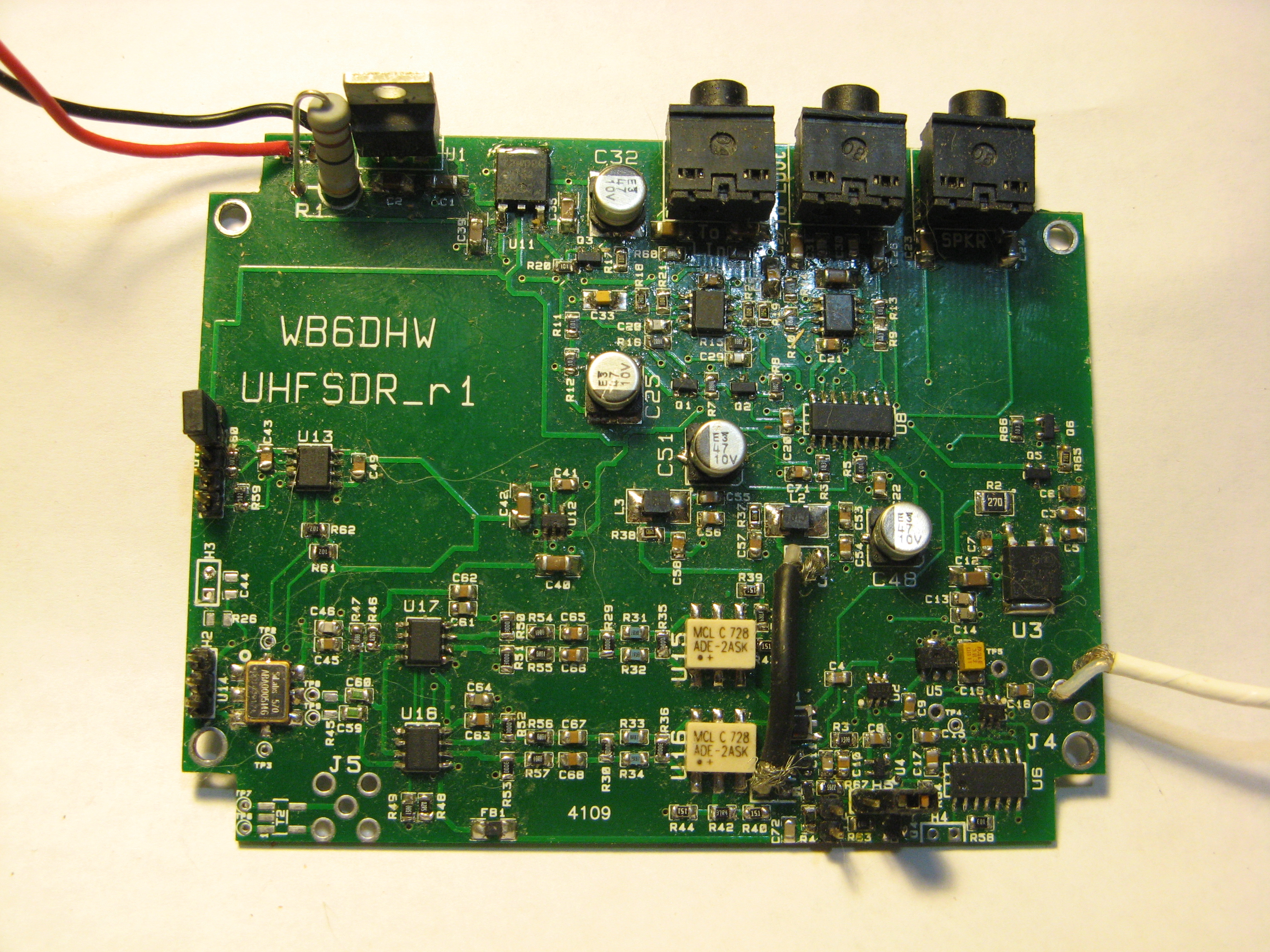
Here it is. Another winter project. This was e-mailed to me by a few anonymous readers. So I had to do some tracking to find the source. Credit to Andrew Sparky and WB6DHW
The UHFSDR is a Software Defined Transceiver covering the 1.75 MHz to 700 MHz frequency range. A Si570 is used for frequency control. Two LVPECL 4 GHz max.flip flops produce I and Q LO signals at 1/2 the Si570 frequency. A pair of 1-1000MHz Double Balanced Mixers are used to convert signals to and from base band.
A receiver pre-amp (2dB noise figure) and a transmit pre-amp(50mW max output) are provided as well as antennal switching plus provision for separate receive and transmit connections.
For additional information, download the Assembly Manual.
The BOM, schematic, and board layout are Here.
A HiRes(3.7MByte.) picture of the completed board is Here
Link to WD6DHW’s Website
Friday, October 29, 2010
Marshall Headphones
Not Ham related, but cool indeed. Having been a guitar player for 35 years I think this is pretty cool. I know many hams who also have battles with the six string axe.
----------------------------------------------------
Everyone knows that you can't really get that full live rock and roll experience without shoving your head against the amp. That said, sometimes it's hard to find a nearby Marshall stack--like, say, when you're at the office or on the subway.
These new Marhsall-branded headphones may be the next thing. At the very least, they sort of look like a pair of amps strapped to the sides of your head.
"These headphones are conceived from Marshall's time-tested fundamentals of performance and endurance, designed to thrive on daily use and to render music the way it was meant to sound, no matter what your flavor is," the company writes in a press release. "The greatest of effort has also been put into the aesthetics, making the headphones ooze of that iconic Marshall look."
If you don't mind a little oozing next to your ears, these things look downright snazzy. Well, at least wall two inches of what we've seen thus far.
Thursday, October 28, 2010
350,000 km Twister
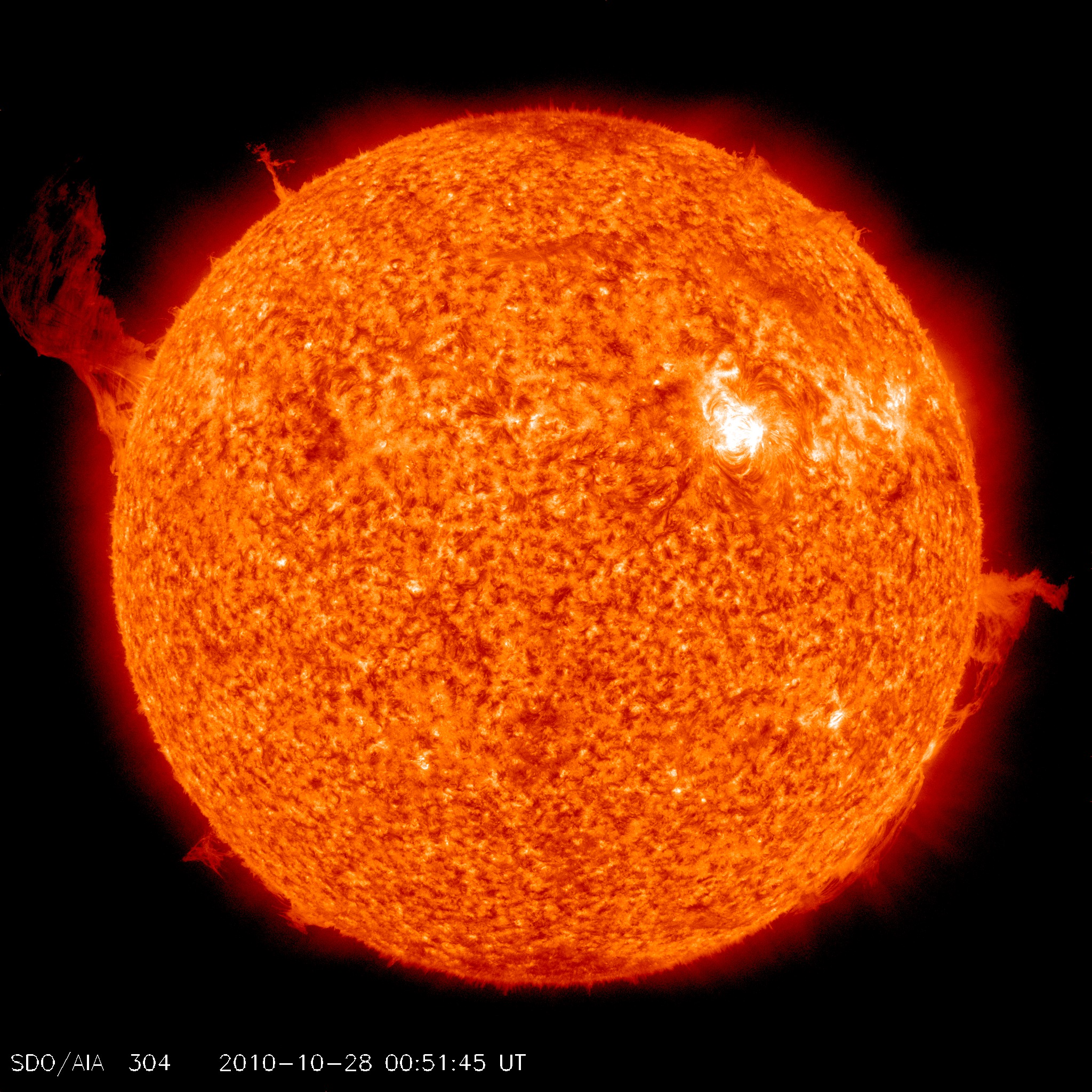
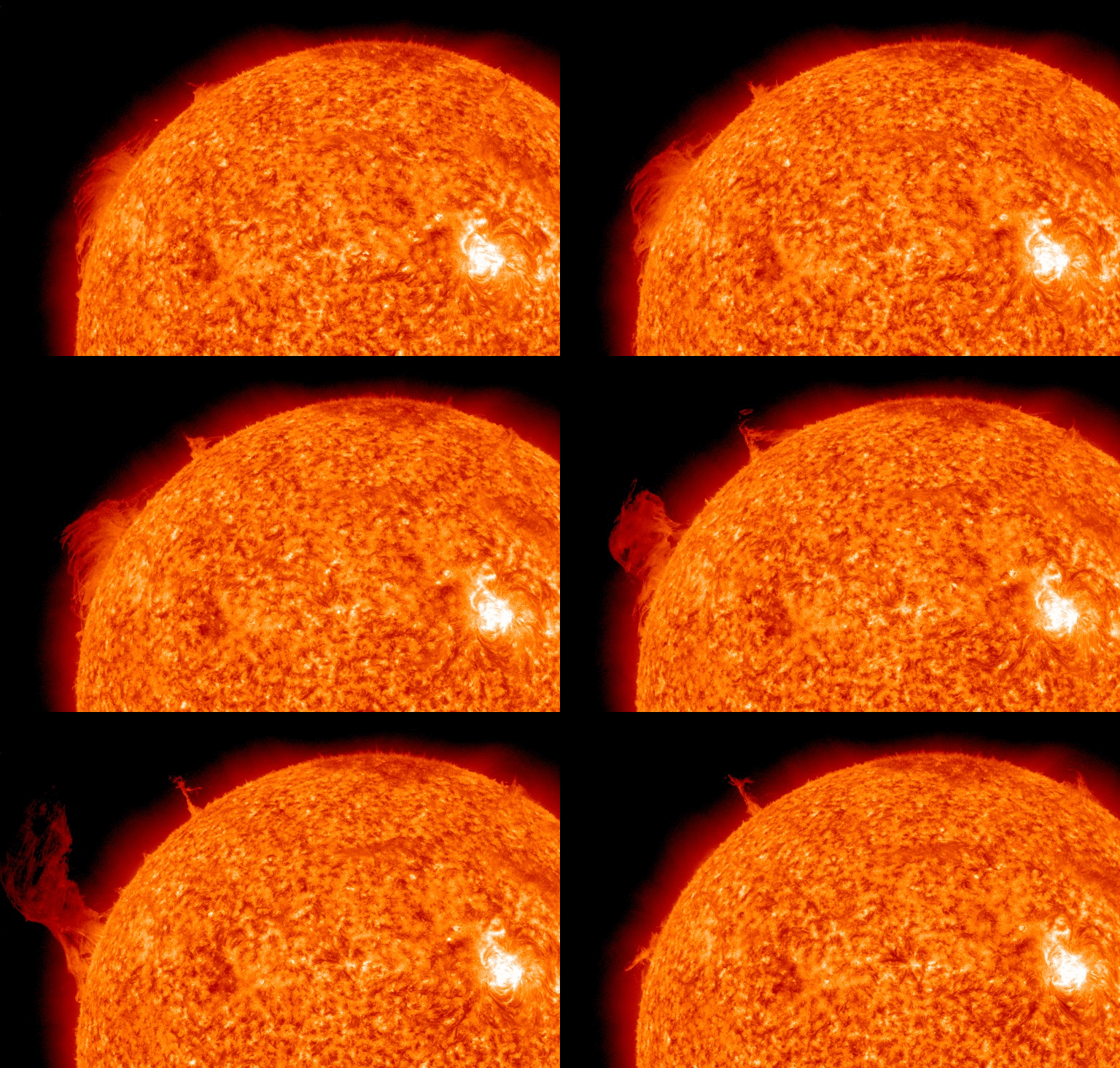
 Earlier today (Oct. 28th) a twisted filament of magnetism on the sun suddenly untwisted. The result was a spectacular eruption recorded in full-disk detail by NASA's Solar Dynamics Observatory.
Movie formats: 8 MB gif, 3 MB gif, 1.7 MB iPad, 0.7 MB iPhone
At its peak, the twister--or rather, untwister--towered more than 350,000 km above the stellar surface. It appears to have hurled a fragment of itself into space, but not toward Earth; the blast was not geoeffective.
Now that the filament has relaxed, it is unlikely to erupt again. The next blast is more likely to come from big sunspot 1117, which NOAA forecasters say could produce an M-class solar flare.
source
I recommend SpaceWeather.com to everyone. I obtain much of my info from there site which I also have in my side bar Space Links and Sites list.
Tuesday, October 26, 2010
Articles of Interest
Radio ham Harry Johnson visits the world from his basement
When Harry Johnson was around three years old, back in 1939 or so, his grandpa carried him upstairs to a magical room at the grandparents’ house in Montana.
It was Uncle Charlie’s room, and Johnson’s memories of it resemble something from an old black-and-white monster movie.
“It was warm, and I remember the glow of vacuum tubes, and electricity sparking,” Johnson said.
Continue Reading
A 16-year-old brought radio to Memphis.
Alfred Cowles, a junior at Central High School, built his own transmitter to play recorded music and read stories during evening broadcasts from his Vance Avenue backyard on Amateur Radio Station 5NZ. The first sound on the airwaves here was the famous tenor Enrico Caruso singing Italian opera. The year was 1920.
Continue Reading
Scouts make contact with submarine
Well over 50 Scouts, mostly Cubs, and their families attended the Lake Area Amateur Radio Klub’s Jamboree on the Air in The Colony on Saturday. In all, there were over 150 attendees, which was an improvement from last year. There were Scouts from The Colony, Little Elm, Lewisville, Flower Mound and Frisco.
Continue Reading
Continue Reading
A 16-year-old brought radio to Memphis.
Alfred Cowles, a junior at Central High School, built his own transmitter to play recorded music and read stories during evening broadcasts from his Vance Avenue backyard on Amateur Radio Station 5NZ. The first sound on the airwaves here was the famous tenor Enrico Caruso singing Italian opera. The year was 1920.
Continue Reading
Scouts make contact with submarine
Well over 50 Scouts, mostly Cubs, and their families attended the Lake Area Amateur Radio Klub’s Jamboree on the Air in The Colony on Saturday. In all, there were over 150 attendees, which was an improvement from last year. There were Scouts from The Colony, Little Elm, Lewisville, Flower Mound and Frisco.
Continue Reading
Sunday, October 24, 2010
Wouxun KG-UV920R Mobile
 UPDATE; Click Here
I'm all for cheaper radios and equipment in this wonderful hobby of Amateur Radio. Being on a fixed income I can only afford used equipment at this point unless I save for several months. Wouxun has plans to release a New Dual Band Mobile unit. It sure looks awesome. Read the Specs. From what I have read it's in the $150-$200 price range. If that is the real price range, it's going to upset the Amateur Radio world as far as prices are concerned.
------------------------------------------------------
The KG-UV920R is Wouxon's first dual band rig, operating both 2 meters and 70 cm (440 MHz). Power output is selectable in 3 steps (2m: 5/25/50W, 70cm: 5/20/40W) and modulation can be switched between narrow-FM and regular-FM. The receiver covers the entire HF band, 65-220 MHz and 400-520 MHz and supports AM. A detachable front panel and DTMF-mic come standard.
- Frequency range RX 0.15-30 / 65-220 / 400-520 MHz
- TX; 2 m / 70 cm
- Modulations RX;AM / FM / N-FM
- TX; FM / N-FM
- Tuning steps; 5 / 6.25 / 10 / 12.5 / 15 / 20 / 25 / 30 / 50 / 100 kHz
- Features;
- DTMF-mic
Detachable front panel
Called ID
Twin RX
Cross-band repeater
Saturday, October 23, 2010
Illness
I have been gone due to Illness.
I hope all of you are doing well.
I am holding my own and hope to resume regular blogging tomorrow.
Thank you to all of you who have sent me e-mails.
73,
de KD8BIG
I hope all of you are doing well.
I am holding my own and hope to resume regular blogging tomorrow.
Thank you to all of you who have sent me e-mails.
73,
de KD8BIG
Monday, October 11, 2010
ASU's Hams are Back On the Air
I always enjoy hearing about Amateur Radio being used and introduced in the schools. My sons school has an Amateur Radio Station, W8MTA. The problem is getting the youth interested in Amateur Radio. My son has sit here in my shack for several hours listening, watching and even occasionally dose some ragchewing. He has even been a part of JOTA with his Boy Scout Troop.
Still he has little interest in getting his license. I have the lap-top, cell phone and Iphone he said. Why do I need more? he asked. Maybe one day.
This article came to me through an e-mail. I wonder how many colleges have Amateur Radio Stations? 73
--------------
Calling CQ: ASU's hams are back on the air
by Judith Smith, jps@asu.edu
Still he has little interest in getting his license. I have the lap-top, cell phone and Iphone he said. Why do I need more? he asked. Maybe one day.
This article came to me through an e-mail. I wonder how many colleges have Amateur Radio Stations? 73
--------------
Calling CQ: ASU's hams are back on the air
by Judith Smith, jps@asu.edu
KC7MOD is Nicholas Radtke, president of W7ASU – ASU’s Amateur Radio Society – and AC7FL is Stuart Lindsay, Regents’ Professor of Biophysics, who is the club’s faculty adviser.
ASU’s “hams” are sharing good news these days with their fellow radio buffs around the world: For the first time in many years, the club has a permanent home.
W7ASU dates back to the 1930s, and actually is one of ASU’s oldest student clubs, said Radtke, a doctoral candidate in computer science. “There was a station on campus, with some breaks, until about 15 years ago. The club’s ‘shack’ was in the old Technology Building, which is now Psychology North, with two towers and multiple antennas on top of the building."
Subscribe to:
Posts (Atom)
My Stamp Collecting Blog