E-mailed to me from Todd KC9BQA
I might jump into this one. Monday is a long way away at the moment.
___________________________________________
The 2m Fall Sprint is on Monday, Sept. 20th, from 7-11pm.
http://www.svhfs.org/2010fallsprintrules.pdf These sprints get
pretty good participation in our part of the world. (HINT: you
gotta talk them up ahead of time so guys will know to get on.)
I have more Sprint info at kc9bqa.com -- post dated Sept 12.
Or go here: http://kc9bqa.com/?p=3470 If you have questions,
email me.
Another link gives 6 reasons why the Sprints are enjoyable --
those 6 reasons are at: http://kc9bqa.com/?p=953
Make plans to get on, and start working toward your WIVUCH
award. Work at least 20 WI counties on any/all VHF/UHF bands
and you receive a nice certificate. This is an ongoing program that
started Jan 1, 2010. All amateurs are welcome, and we need more
counties to work so get on and join in the fun. Out-of-state hams are definitely welcome. I hope other states will start up VHF/UHF county award programs in time.
Click on the WIVUCH link below for more info.
73,
Todd KC9BQA EN63ao 40 N of Milwaukee
www.kc9bqa.com For Frequent VHF/UHF Updates
www.wivuch.com WI VHF/UHF County Hunters Award
Thursday, September 16, 2010
New Sun Spot
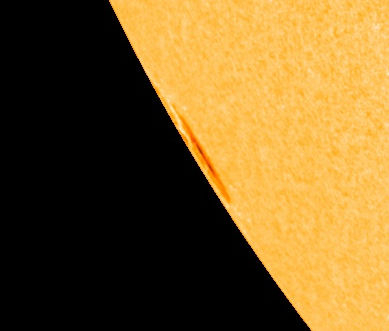
 A new sunspot is emerging over the sun's southeastern limb, and its magnetic canopy is seething with activity. Click on the image to watch 90 minutes of action recorded during the late hours of Sept. 15th by NASA's Solar Dynamics Observatory:
movie formats: 2.5 MB mpeg, 1.0 MB iPad, 2.2 MB avi
Because the sunspot's dark core is visible only in profile, its characteristics are a matter of guesswork. NOAA forecasters say that "C-class events are likely." If so, the eruptions will blow into space over the sun's limb--a nice photo-op for readers with solar telescopes. Stay tuned for updates and better views as the sunspot turns toward Earth
source

Wednesday, September 15, 2010
Citizens Band vs Amateur Radio Equipment
I heard this on the ARRL Audio News.
The story brought me back to the days of my youth when CB Radio was cool.
I remember the days we spent modifying our radios, buying power mics, and shooting skip. That is the equivalent to working DX.
I'm happy to say I am far beyond those days. I have a CB radio but it no longer works. I have a few Hand Held CB radios I bought several years ago to keep in touch with my wife while camping and taking walks on our 100 acre property.
--------------------
The story brought me back to the days of my youth when CB Radio was cool.
I remember the days we spent modifying our radios, buying power mics, and shooting skip. That is the equivalent to working DX.
I'm happy to say I am far beyond those days. I have a CB radio but it no longer works. I have a few Hand Held CB radios I bought several years ago to keep in touch with my wife while camping and taking walks on our 100 acre property.
--------------------
ARRL Comments in FCC Review of CB Rules
In June the FCC opened a proceeding -- WT Docket No. 10-119 -- “to simplify, streamline, and update the Part 95 rules to reflect technological advances and changes in the way the American public uses the various Personal Radio Services.” The Citizens Band (CB) Radio Service is one of several Personal Radio Services regulated by Part 95. Three of the CB-related issues raised in the Notice of Proposed Rule Making (NPRM) are of interest to the Amateur Radio Service. On September 3, the ARRL filed comments limited to these issues.
Citizens Band vs Amateur Radio Equipment
In the NPRM, the FCC sought to consolidate the rules pertaining to the modification of certificated CB equipment. The Commission noted that CB equipment that has been modified by the CB operator -- or persons other than the manufacturer -- to operate on unauthorized frequencies or to operate with higher power than authorized often causes interference to other radio services. “Indeed, there are many recent instances of the operation of modified CB equipment (or equipment imported or manufactured domestically with the inherent capability of operating outside the HF CB channels) by unlicensed individuals in the Amateur Radio Service bands,” the ARRL agreed, saying that this interference most often occurs in the 28.000-28.500 MHz segment of the amateur 10 meter band.
Long Distance CB Communication
In the NPRM, the Commission discussed the current prohibition on CB communications between two stations located more than 250 kilometers apart. The rule, Section 95.413(a)(9), is intended to discourage CB skywave communications. This rule, the NPRM states, is necessary because of the need for frequency reuse (what the Commission refers to as a “commons” band regulatory structure). The ARRL supports the existing Part 95 rule against long-distance CB communication.
Click Here to read full Article
Tuesday, September 14, 2010
Amateur Radio in China
This is a bunch of pooooo……..
I hope this dose not give the Democrats and Liberals any ideas.
Although I am not a member of the ARRL, I am thankful for them. They do help maintain the privileges we as Amateurs do have.
---------
The city's fast-growing number of radio hams has been told to register ahead of a new national regulation aimed at tightening control over amateur radio stations.
Beijing Radio Administration Bureau sent a message to ham radio operators on Saturday calling on them to register.
Any ham radio stronger than 0.5 watts must be registered.
read more here
I hope this dose not give the Democrats and Liberals any ideas.
Although I am not a member of the ARRL, I am thankful for them. They do help maintain the privileges we as Amateurs do have.
---------
The city's fast-growing number of radio hams has been told to register ahead of a new national regulation aimed at tightening control over amateur radio stations.
Beijing Radio Administration Bureau sent a message to ham radio operators on Saturday calling on them to register.
Any ham radio stronger than 0.5 watts must be registered.
read more here
Saturday, September 11, 2010

Wednesday, September 8, 2010
Ham Radio's Technical Culture
 Wow, what a cool read. I got this book the other day from a friend who found it while hitting the yard sales. This book is available on E-Bay and at Amazon.com.
Author; Kristen Haring
Table of Contents and Sample Chapters
Decades before the Internet, ham radio provided instantaneous, global, person-to-person communication. Hundreds of thousands of amateur radio operators—a predominantly male, middle- and upper-class group known as "hams"—built and operated two-way radios for recreation in mid twentieth century America. In Ham Radio's Technical Culture, Kristen Haring examines why so many men adopted the technical hobby of ham radio from the 1930s through 1970s and how the pastime helped them form identity and community.
Ham radio required solitary tinkering with sophisticated electronics equipment, often isolated from domestic activities in a "radio shack," yet the hobby thrived on fraternal interaction. Conversations on the air grew into friendships, and hams gathered in clubs or met informally for "eyeball contacts." Within this community, hobbyists developed distinct values and practices with regard to radio, creating a particular "technical culture." Outsiders viewed amateur radio operators with a mixture of awe and suspicion, impressed by hams' mastery of powerful technology but uneasy about their contact with foreigners, especially during periods of political tension.
Drawing on a wealth of personal accounts found in radio magazines and newsletters and from technical manuals, trade journals, and government documents, Haring describes how ham radio culture rippled through hobbyists' lives. She explains why hi-tech employers recruited hams and why electronics manufacturers catered to these specialty customers. She discusses hams' position within the military and civil defense during World War II and the Cold War as well as the effect of the hobby on family dynamics. By considering ham radio in the context of other technical hobbies—model building, photography, high-fidelity audio, and similar leisure pursuits—Haring highlights the shared experiences of technical hobbyists. She shows that tinkerers influenced attitudes toward technology beyond hobby communities, enriching the general technical culture by posing a vital counterpoint.
Tuesday, September 7, 2010
School of Soldering
I (KD8BIG) am an...
Alfred E. Neuman's School of Soldering
DROPOUT, and proud of it!!! :o)

Alfred E. Neuman's School of Soldering
DROPOUT, and proud of it!!! :o)

Monday, September 6, 2010
Update; SOLAR FLARE:
A little more than an hour ago, magnetic fields above sunspot 1105 reconnected, producing a brief but explosive C1-class solar flare. NASA's Solar Dynamics Observatory recorded a bright flash of extreme UV radiation from the blast site: 0.7 MB movie. Sunspot 1105 is growing rapidly and seems poised to produce more flares in the hours ahead.
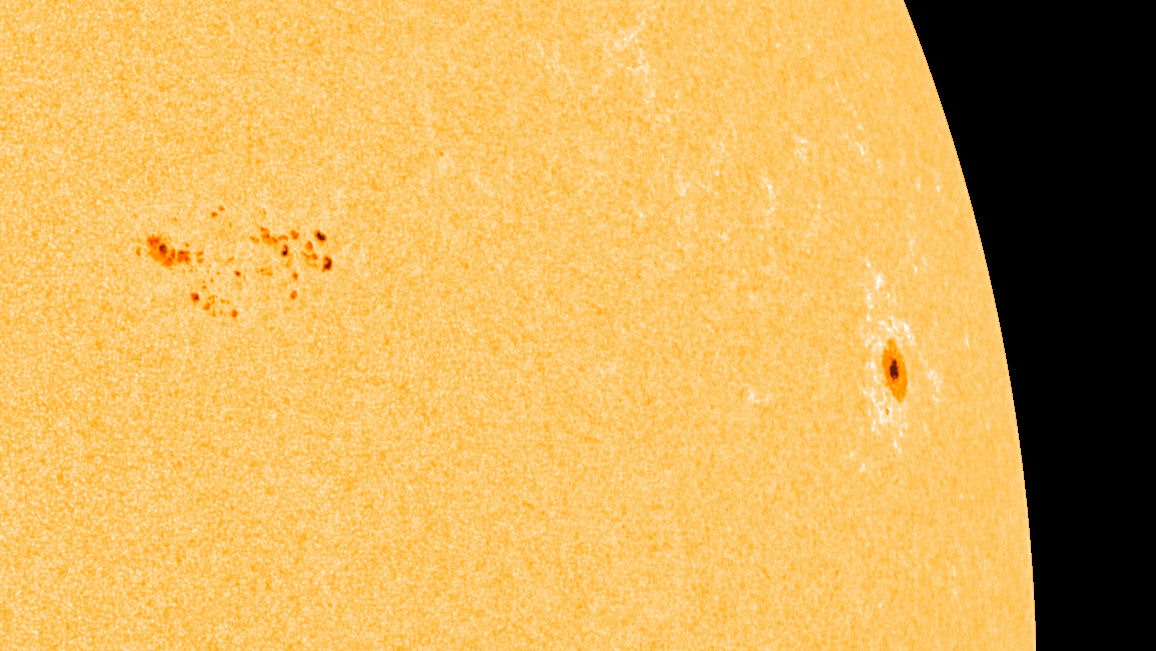
It looks like the sun has developed rash. Sunspot group 1105 consists of more than 25 tiny spots scattered across an area some 40,000 km wide. Sascha Somodji sends this picture of the busy active region from his backyard observatory in Krefeld, Germany:
It looks like the sun has developed rash. Sunspot group 1105 consists of more than 25 tiny spots scattered across an area some 40,000 km wide. Sascha Somodji sends this picture of the busy active region from his backyard observatory in Krefeld, Germany:
Sunspot group 1105 stands in marked contrast to nearby sunspot 1101, which consists of a single dark core. (Click here to see the two side by side.) If sunspot 1101 looks boring, that's because it is. The sunspot's magnetic underpinnings resemble a simple dipole, and the spot is correspondingly quiet. Sunspot group 1105, on the other hand, is much more complicated with a profusion of opposite magnetic polarities popping up and bumping together. Magnetic reconnection is happening there almost non-stop, causing sunspot 1105 to crackle with B-class solar flares. It is, indeed, a "rash sunspot."
more images: from Steve Rismiller of Milford, Ohio; from John Stetson of Portland, Maine; from Rolf Girssmann of Boostedt, Germany; from Cai-Uso Wohler of Bispingen, Germany;
The Amateur's Code.
I remember the first time I read this. I had my ticket for about 2-3 weeks. I have it in a frame here in the shack. It was on the wall at one time.
Sometimes these rules are forgotten. So I figured it was a good time to post.
Sometimes these rules are forgotten. So I figured it was a good time to post.
The Amateur's Code
The Radio Amateur is CONSIDERATE...never knowingly operates in such a way as to lessen the pleasure of others.LOYAL...offers loyalty, encouragement and support to other amateurs, local clubs, and the American Radio Relay League, through which Amateur Radio in the United States is represented nationally and internationally.
PROGRESSIVE...with knowledge abreast of science, a well-built and efficient station and operation above reproach.
FRIENDLY...slow and patient operating when requested; friendly advice and counsel to the beginner; kindly assistance, cooperation and consideration for the interests of others. These are the hallmarks of the amateur spirit.
BALANCED...radio is an avocation, never interfering with duties owed to family, job, school or community.
PATRIOTIC...station and skill always ready for service to country and community.
Sunday, September 5, 2010
Uniden HomePatrol
OMG, I got to get me one of these. When I saw the price I was shocked. Then after doing some research I have discovered that some of these units are all ready in the public.
I could not believe how technologically advanced this scanner is.
When I get this unit I will write a review.
Here are a couple of videos along with a couple of links.
HomePatrol web-site
HomePatrol Demo
What You will Receive; enter your zip code
I could not believe how technologically advanced this scanner is.
When I get this unit I will write a review.
Here are a couple of videos along with a couple of links.
HomePatrol web-site
HomePatrol Demo
What You will Receive; enter your zip code
Saturday, September 4, 2010
Sun - Diferentional rotation of plasma
A question was asked; Dose the Sun Rotate?
This is a great video with the answer.
This is a great video with the answer.
Wednesday, September 1, 2010
M.A.A.R.C. 2 Meter Net
I'm NCS tonight on the M.A.A.R.C. 2 meter net. Due to the current Hurricane and other Tropical Storms in the Atlantic I think I will talk about the Hurricane Watch Net.
The Hurricane Watch Net was established in 1965 for the purpose of providing support to the National Hurricane Center during times of tropical storm emergencies. Through our associated network of Amateur Radio Operators, emergency communications support to the NHC is of primary interest.
The Hurricane Watch Net and the operation at WX4NHC at the National Hurricane Center in Miami are manned entirely by volunteers. We activate whenever a system has achieved hurricane status and is within 300 miles of populated land mass or at the request of the National Hurricane Center.
Net operations are conducted on 14.325 MHz.
For more info on the Hurricane Watch Net visit their web-site; http://www.hwn.org/
The Hurricane Watch Net was established in 1965 for the purpose of providing support to the National Hurricane Center during times of tropical storm emergencies. Through our associated network of Amateur Radio Operators, emergency communications support to the NHC is of primary interest.
The Hurricane Watch Net and the operation at WX4NHC at the National Hurricane Center in Miami are manned entirely by volunteers. We activate whenever a system has achieved hurricane status and is within 300 miles of populated land mass or at the request of the National Hurricane Center.
Net operations are conducted on 14.325 MHz.
The Hurricane Watch Net serves two purposes:
- To disseminate the latest National Weather Service advisories on active hurricanes in both the Atlantic and Pacific side of the Americas. This includes transmissions to any maritime amateur radio operators that may be in the affected area.
- To gather real-time ground level weather conditions from amateurs in the affected areas and to get these reports to the National Hurricane Center via WX4NHC in a timely and accurate fashion.
For more info on the Hurricane Watch Net visit their web-site; http://www.hwn.org/
Monday, August 30, 2010
TechNet
On August 5th, I went to the M.A.A.R.C. Meeting and discussed to those in attendance about the club hosting a TechNet on the 146.940 repeater.
This is a sample of what I am thinking of in response from of those interested in being a part of the TechNet;
M.A.A.R.C. TechNet.
Topics include the latest news in the worlds manned and unmanned space programs, aeronautics, astronomy events and new discoveries. We will also cover Amateur Astronomy, Model, Mid and High Powered Rocketry, as well as Amateur Radio activities related to space such as monitoring meteor activity, contacting the International Space Station, using Amateur Radio Satellites, EME (Moonbounce) and how to use Orbital Plotting software.
Outside of Space topics we will also discuss;
How to use your radio, Radio Orienteering,Building mini transmitters for ROCA, Antenna Construction,Sound Card-to-Rig Interfaces, Cables and Connectors, DSP Manufacturers, Interfaces Manufacturers, Radio Manufacturers, Packet Radio, PSK31, Radio Programming Cables, RTTY, Ham Radio Software, Networking issues, Operating System issues and many other High Tech Radio-Computer related issues. This is just a few suggestions.
This is a sample of what I am thinking of in response from of those interested in being a part of the TechNet;
M.A.A.R.C. TechNet.
Topics include the latest news in the worlds manned and unmanned space programs, aeronautics, astronomy events and new discoveries. We will also cover Amateur Astronomy, Model, Mid and High Powered Rocketry, as well as Amateur Radio activities related to space such as monitoring meteor activity, contacting the International Space Station, using Amateur Radio Satellites, EME (Moonbounce) and how to use Orbital Plotting software.
Outside of Space topics we will also discuss;
How to use your radio, Radio Orienteering,Building mini transmitters for ROCA, Antenna Construction,Sound Card-to-Rig Interfaces, Cables and Connectors, DSP Manufacturers, Interfaces Manufacturers, Radio Manufacturers, Packet Radio, PSK31, Radio Programming Cables, RTTY, Ham Radio Software, Networking issues, Operating System issues and many other High Tech Radio-Computer related issues. This is just a few suggestions.
Saturday, August 28, 2010
Tower Climb to 1768 Feet
This is being sent on twitter and e-mails. Seems like everyone is seeing it. I would climb this tower.
Friday, August 27, 2010
Earth's atmosphere/ Shrinking
THE upper reaches of Earth's atmosphere are unexpectedly shrinking and cooling due to lower ultraviolet radiation from the sun, US scientists say.
The sun's energy output dropped to unusually low levels from 2007 to 2009, a significantly long spell with virtually no sunspots or solar storms, according to scientists from the National Centre for Atmospheric Research in Boulder, Colorado.
During that period, the thermosphere, whose altitude ranges from about 90-500km, shrank and contracted from the sharp drop in ultraviolet radiation, said the study published in the American Geophysical Union's journal Geophysical Research Letters.
A narrower, less dense thermosphere is good news for satellites orbiting Earth, including the International Space Station, since reduced friction means they can remain aloft longer, said University of Colorado professor and study co-author Thomas Woods.
source
The sun's energy output dropped to unusually low levels from 2007 to 2009, a significantly long spell with virtually no sunspots or solar storms, according to scientists from the National Centre for Atmospheric Research in Boulder, Colorado.
During that period, the thermosphere, whose altitude ranges from about 90-500km, shrank and contracted from the sharp drop in ultraviolet radiation, said the study published in the American Geophysical Union's journal Geophysical Research Letters.
A narrower, less dense thermosphere is good news for satellites orbiting Earth, including the International Space Station, since reduced friction means they can remain aloft longer, said University of Colorado professor and study co-author Thomas Woods.
source
Subscribe to:
Posts (Atom)
My Stamp Collecting Blog